Saturday, 19 September 2026
Friday, 18 September 2026
Thursday, 17 September 2026
Tuesday, 15 September 2026
Monday, 14 September 2026
Sunday, 13 September 2026
Monday, 10 August 2026
Wednesday, 17 June 2026
Sunday, 14 June 2026
Friday, 12 June 2026
Thursday, 11 June 2026
Sunday, 07 June 2026
Friday, 05 June 2026
Thursday, 04 June 2026
Wednesday, 03 June 2026
Tuesday, 02 June 2026
Monday, 01 June 2026
Sunday, 31 May 2026
Saturday, 30 May 2026
Friday, 29 May 2026
Tuesday, 26 May 2026
Wednesday, 06 May 2026
Monday, 27 April 2026
Sunday, 26 April 2026
Saturday, 25 April 2026
Thursday, 23 April 2026
Saturday, 18 April 2026
Friday, 03 April 2026
Saturday, 07 March 2026
Sunday, 22 February 2026
Monday, 28 December 2025
Sunday, 11 October 2025
Sunday, 27 September 2025
Saturday, 19 September 2025
Monday, 07 September 2025
Sunday, 23 August 2025
Sunday, 07 June 2025
Sunday, 24 May 2025
Saturday, 23 May 2025
Friday, 17 April 2025
Sunday, 12 April 2025
Monday, 23 March 2025
Sunday, 08 March 2025
Tuesday, 24 February 2025
Saturday, 21 February 2025
Saturday, 07 February 2025
Friday, 06 February 2025
Wednesday, 04 February 2025
Sunday, 25 January 2025
Thursday, 17 December 2024
Monday, 07 December 2024
Saturday, 05 December 2024
Tuesday, 01 December 2024
Thursday, 12 November 2024
Monday, 02 November 2024
Saturday, 17 October 2024
Tuesday, 29 September 2024
Sunday, 27 September 2024
Saturday, 26 September 2024
Tuesday, 08 September 2024
Monday, 07 September 2024
Thursday, 03 September 2024
Wednesday, 02 September 2024
Tuesday, 01 September 2024
Monday, 31 August 2024
Saturday, 29 August 2024
Monday, 24 August 2024
Saturday, 22 August 2024
Tuesday, 18 August 2024
Saturday, 15 August 2024
Tuesday, 11 August 2024
Sunday, 09 August 2024
Saturday, 08 August 2024
Thursday, 06 August 2024
Tuesday, 04 August 2024
Friday, 31 July 2024
Tuesday, 28 July 2024
Saturday, 25 July 2024
Thursday, 23 July 2024
Saturday, 18 July 2024
Monday, 22 June 2024
Wednesday, 10 June 2024
Sunday, 07 June 2024
Saturday, 06 June 2024
Wednesday, 03 June 2024
Sunday, 24 May 2024
Tuesday, 19 May 2024
Monday, 18 May 2024
Sunday, 17 May 2024
Friday, 08 May 2024
Sunday, 03 May 2024
Wednesday, 29 April 2024
Monday, 20 April 2024
Friday, 10 April 2024
Monday, 09 March 2024
Monday, 02 March 2024
Sunday, 01 March 2024
Sunday, 22 February 2024
Tuesday, 10 February 2024
Sunday, 08 February 2024
Tuesday, 20 January 2024
Wednesday, 23 December 2023
Tuesday, 22 December 2023
Monday, 21 December 2023
Sunday, 20 December 2023
Tuesday, 01 December 2023
Friday, 27 November 2023
Sunday, 22 November 2023
Tuesday, 17 November 2023
Tuesday, 03 November 2023
Saturday, 31 October 2023
Monday, 26 October 2023
Monday, 19 October 2023
Sunday, 04 October 2023
Sunday, 27 September 2023
Tuesday, 22 September 2023
Monday, 21 September 2023
Thursday, 17 September 2023
Tuesday, 15 September 2023
Thursday, 20 August 2023
Tuesday, 18 August 2023
Monday, 27 July 2023
Friday, 24 July 2023
Wednesday, 24 June 2023
Thursday, 04 June 2023
Monday, 01 June 2023
Sunday, 31 May 2023
Friday, 29 May 2023
Wednesday, 20 May 2023
Tuesday, 19 May 2023
Monday, 18 May 2023
Sunday, 17 May 2023
Saturday, 16 May 2023
Friday, 15 May 2023
Thursday, 14 May 2023
Tuesday, 12 May 2023
Monday, 11 May 2023
Saturday, 09 May 2023
Friday, 08 May 2023
Monday, 04 May 2023
Saturday, 02 May 2023
Monday, 27 April 2023
Sunday, 19 April 2023
Tuesday, 14 April 2023
Sunday, 05 April 2023
Tuesday, 24 March 2023
Wednesday, 18 March 2023
Tuesday, 17 March 2023
Saturday, 14 March 2023
Friday, 13 March 2023
Saturday, 07 March 2023
Sunday, 01 March 2023
Monday, 23 February 2023
Sunday, 22 February 2023
Saturday, 21 February 2023
Wednesday, 18 February 2023
Tuesday, 17 February 2023
Monday, 16 February 2023
Saturday, 14 February 2023
Friday, 13 February 2023
Thursday, 12 February 2023
Tuesday, 10 February 2023
Sunday, 08 February 2023
Saturday, 07 February 2023
Friday, 06 February 2023
Wednesday, 04 February 2023
Saturday, 31 January 2023
Thursday, 29 January 2023
Friday, 23 January 2023
Thursday, 22 January 2023
Wednesday, 21 January 2023
Tuesday, 20 January 2023
Sunday, 18 January 2023
Saturday, 17 January 2023
Friday, 16 January 2023
Tuesday, 13 January 2023
Sunday, 11 January 2023
Sunday, 04 January 2023
Monday, 21 December 2022
Sunday, 20 December 2022
Saturday, 19 December 2022
Tuesday, 15 December 2022
Saturday, 12 December 2022
Monday, 07 December 2022
Sunday, 29 November 2022
Saturday, 21 November 2022
Monday, 16 November 2022
Wednesday, 11 November 2022
Sunday, 08 November 2022
Sunday, 18 October 2022
Monday, 12 October 2022
Sunday, 11 October 2022
Tuesday, 06 October 2022
Saturday, 03 October 2022
Saturday, 26 September 2022
Monday, 21 September 2022
Monday, 14 September 2022
Tuesday, 08 September 2022
Sunday, 30 August 2022
Wednesday, 26 August 2022
Monday, 24 August 2022
Tuesday, 18 August 2022
Monday, 27 July 2022
Wednesday, 22 July 2022
Saturday, 18 July 2022
Tuesday, 14 July 2022
Saturday, 11 July 2022
Wednesday, 24 June 2022
Tuesday, 16 June 2022
Wednesday, 10 June 2022
Thursday, 04 June 2022
Tuesday, 02 June 2022
Monday, 01 June 2022
Sunday, 31 May 2022
Saturday, 30 May 2022
Sunday, 24 May 2022
Sunday, 17 May 2022
Thursday, 14 May 2022
Tuesday, 12 May 2022
Monday, 04 May 2022
Tuesday, 28 April 2022
Sunday, 19 April 2022
Saturday, 18 April 2022
Friday, 17 April 2022
Wednesday, 15 April 2022
Monday, 13 April 2022
Saturday, 11 April 2022
Wednesday, 08 April 2022
Monday, 06 April 2022
Wednesday, 01 April 2022
Tuesday, 31 March 2022
Saturday, 28 March 2022
Thursday, 26 March 2022
Tuesday, 24 March 2022
Wednesday, 18 March 2022
Tuesday, 17 March 2022
Tuesday, 10 March 2022
Saturday, 07 March 2022
Wednesday, 04 March 2022
Tuesday, 03 March 2022
Wednesday, 18 February 2022
Monday, 16 February 2022
Saturday, 14 February 2022
Wednesday, 11 February 2022
Tuesday, 03 February 2022
Sunday, 01 February 2022
Wednesday, 28 January 2022
Sunday, 25 January 2022
Saturday, 24 January 2022
Wednesday, 21 January 2022
Tuesday, 20 January 2022
Monday, 19 January 2022
Saturday, 17 January 2022
Tuesday, 13 January 2022
Monday, 12 January 2022
Saturday, 10 January 2022
Wednesday, 07 January 2022
Saturday, 03 January 2022
Wednesday, 23 December 2021
Monday, 21 December 2021
Tuesday, 15 December 2021
Monday, 14 December 2021
Monday, 07 December 2021
Thursday, 03 December 2021
Wednesday, 02 December 2021
Sunday, 29 November 2021
Thursday, 26 November 2021
Wednesday, 25 November 2021
Tuesday, 24 November 2021
Monday, 23 November 2021
Sunday, 22 November 2021
Wednesday, 18 November 2021
Monday, 16 November 2021
Saturday, 14 November 2021
Monday, 09 November 2021
Tuesday, 27 October 2021
Wednesday, 21 October 2021
Monday, 19 October 2021
Sunday, 18 October 2021
Monday, 12 October 2021
Sunday, 27 September 2021
Monday, 21 September 2021
Sunday, 20 September 2021
Saturday, 19 September 2021
Thursday, 10 September 2021
Monday, 07 September 2021
Sunday, 06 September 2021
Thursday, 03 September 2021
Wednesday, 02 September 2021
Sunday, 23 August 2021
Monday, 17 August 2021
Sunday, 16 August 2021
Monday, 10 August 2021
Sunday, 02 August 2021
Tuesday, 28 July 2021
Monday, 27 July 2021
Thursday, 23 July 2021
Monday, 20 July 2021
Sunday, 19 July 2021
Sunday, 05 July 2021
Sunday, 28 June 2021
Wednesday, 24 June 2021
Tuesday, 23 June 2021
Monday, 15 June 2021
Sunday, 14 June 2021
Tuesday, 09 June 2021
Monday, 08 June 2021
Sunday, 07 June 2021
Wednesday, 03 June 2021
Wednesday, 27 May 2021
Monday, 25 May 2021
Thursday, 21 May 2021
Wednesday, 20 May 2021
Sunday, 17 May 2021
Sunday, 10 May 2021
Tuesday, 05 May 2021
Sunday, 03 May 2021
Tuesday, 28 April 2021
Monday, 27 April 2021
Wednesday, 15 April 2021
Tuesday, 31 March 2021
Tuesday, 24 March 2021
Monday, 23 March 2021
Thursday, 19 March 2021
Monday, 16 March 2021
Thursday, 05 March 2021
Wednesday, 04 March 2021
Tuesday, 03 March 2021
Monday, 23 February 2021
Friday, 20 February 2021
Thursday, 19 February 2021
Wednesday, 18 February 2021
Friday, 13 February 2021
Wednesday, 11 February 2021
Tuesday, 10 February 2021
Tuesday, 05 May 2020
Sunday, 15 March 2020
Saturday, 14 March 2020
Thursday, 12 February 2020
Friday, 23 January 2020
Friday, 16 January 2020
Thursday, 15 January 2020
Wednesday, 14 January 2020
Thursday, 17 December 2019
Wednesday, 04 February 2016
News Blog
PVC Privacy Fencing in Windy Areas | Value Fencing®

PVC Privacy Fencing in Windy Areas | Value Fencing®
Author: Willie Labuschagne - MD - Value Fencing®
Date: 2026-09-15
Date: 2026-09-15
PVC Privacy Fencing in High-Wind Areas: Why Posts, Reinforcement, Foundations & Fence Solidity Matter
A privacy fence and an open picket fence may be exactly the same height.
That does not mean they experience wind in the same way.
The more solid a fence becomes, the greater the surface area presented to the wind. That makes the parts of the fence you often cannot see increasingly important:
- Posts
- Internal reinforcement
- Horizontal rails
- Post spacing
- Foundations
- Connections
- Ground conditions
- Site exposure
For homeowners, architects, developers, estate managers and contractors, this leads to one of the most important questions to ask before choosing a privacy fence:
Is the fence simply designed to look private - or has the complete system been considered for the environment in which it will stand?
At Value Fencing®, we believe a privacy fence should be evaluated as a complete installed system, not simply as a row of attractive PVC panels.
Quick Answer: Why Does Wind Matter More With Privacy Fencing?
Wind acts on the exposed surface of a fence.
An open palisade or picket fence allows a significant amount of air to pass through its openings.
A substantially solid privacy fence allows far less air through.
That means more wind pressure can act against the face of the barrier.
Those forces must then be transferred through the complete fence system:
- PVC infill panels
- Horizontal rails
- Internal reinforcement
- Rail-to-post connections
- Posts
- Post reinforcement
- Concrete foundations
- Surrounding ground
This is why a good privacy fence cannot be designed by considering only the PVC that is visible above ground.
The entire structural load path matters.
What Does SANS 10160-3 Have to Do With Fencing?
South Africa's structural design framework includes SANS 10160-3 - Wind Actions.
The standard addresses natural wind actions on structures and includes provisions relevant to free-standing walls and fences.
An important part of understanding wind behaviour is the solidity of the barrier.
A predominantly solid privacy fence behaves differently from a highly open or permeable fence.
Wind effects can also be influenced by:
- Geographic location
- Terrain
- Topography
- Fence height
- Fence dimensions
- Barrier solidity
- Surrounding buildings
- Exposure
- Prevailing wind direction
- Elevation
This is why broad marketing claims such as "This fence can withstand X km/h wind anywhere in South Africa" should be treated cautiously unless the assumptions and structural conditions behind the claim are clearly defined.
A fence in a sheltered suburban courtyard does not experience the same exposure as a fence on an elevated coastal property facing prevailing winds.
Why Solid Privacy Fencing Needs More Structural Attention
Imagine standing outside in strong wind while holding two objects.
One is a mesh screen.
The other is a solid sheet.
The solid sheet is substantially harder to control because more of the moving air acts against its surface.
A solid privacy fence follows the same basic principle.
The characteristic homeowners want most - privacy - also creates a larger effective wind-catching surface.
That does not mean privacy fencing is unsuitable for windy areas.
It means the system needs to be properly configured for the site.
What Is Value Fencing® Private Fencing Made From?
Value Fencing® Private fencing uses interlocking PVC infill panels to create a continuous privacy barrier.
The system incorporates 22 mm thick ribbed tongue-and-groove PVC panels assembled into approximately 287 mm modules.
The tongue-and-groove configuration provides a clean, continuous visual barrier while forming part of the complete PVC fencing system.
Depending on the installation, factors such as fence height, exposure, post spacing and ground conditions can justify a heavier-duty configuration.
For more demanding applications, Value Fencing® can use three-rail Private fence configurations to provide additional support.
The important principle is simple:
The fence should be configured for the property - not simply chosen from a photograph.
Why Do Horizontal Rails Matter?
Horizontal rails transfer forces from the privacy infill towards the supporting posts.
As fence height and exposure increase, rail configuration becomes increasingly important.
A lower or more sheltered fence may not require the same structural configuration as a tall solid privacy fence on an exposed coastal property.
Value Fencing® therefore has heavy-duty three-rail Private configurations for appropriate applications.
Our heavier systems can also incorporate substantial profiles such as the 38 × 140 mm rib rail, depending on the particular fence design.
Good design is not about simply adding more material.
It is about selecting an appropriate combination of:
- Fence height
- Span
- Wind exposure
- Ground conditions
- Fence configuration
- Property layout
- Intended use
Why Post Spacing Matters
One of the easiest ways to reduce the cost of a fence quotation is to use fewer posts.
That does not necessarily produce a better fence.
Every section between two posts creates a structural span.
As that span increases, the rails need to carry forces over a greater distance before transferring them into the next post.
For relevant Value Fencing® screening systems, structural spans are typically kept to approximately 1 465 mm or less, depending on the particular configuration and site.
The correct spacing still needs to be matched to the application.
This is why two quotations for exactly the same number of metres can represent very different structures.
One may contain:
- More posts
- Shorter spans
- Additional rails
- More reinforcement
- Larger or more appropriate foundations
while another may simply use fewer structural components.
Comparing only the price per metre can therefore be misleading.
Why Posts Are So Important
The posts form the primary connection between the fence above ground and the supporting foundation below ground.
When wind acts against a solid privacy fence, the posts have to resist bending and transfer the resulting forces down into the foundations and surrounding ground.
A hollow decorative PVC post should therefore not automatically be assumed to provide the complete structural solution for every application.
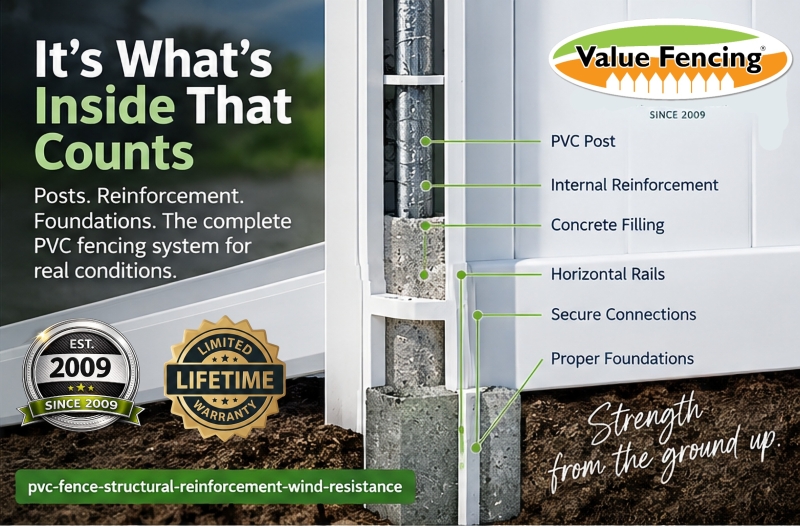
Depending on the system and installation, Value Fencing® posts can incorporate:
- Internal reinforcement
- Concrete filling
- Reinforcing members
- Site-specific foundation detailing
For selected coastal applications, GFRP reinforcement may also be used where appropriate as part of a corrosion-conscious construction approach.
Why Foundations Matter Just as Much as the Fence
A strong fence installed into an inadequate footing can still perform poorly.
The foundation transfers forces from the post into the ground.
Appropriate footing requirements can be influenced by:
- Fence height
- Fence solidity
- Post spacing
- Wind exposure
- Soil conditions
- Filled or disturbed ground
- Coastal sand
- Retaining conditions
- Nearby walls
- Existing concrete
- Sloping ground
- Drainage
There is therefore no responsible universal statement such as:
"Every privacy fence only needs a hole of exactly this size."
The correct foundation depends on the site.
A footing suitable for dense, stable inland ground may not automatically be suitable for loose coastal sand or recently filled soil.
What Happens When Privacy Fencing Is Installed Above a Wall?
Wall-mounted fencing introduces another structural consideration.
When a fence is installed on or above an existing masonry or concrete wall, wind forces acting on the new fence are transferred into that supporting wall.
The PVC fence itself may be strong while the existing wall underneath it is not.
Before installing a privacy screen or wall raiser, it is therefore sensible to consider:
- What is the wall constructed from?
- How thick is it?
- Is it reinforced?
- Are there columns or piers?
- What condition is the mortar in?
- Are there existing cracks?
- How much additional height is being added?
- How solid will the new screen be?
- How exposed is the property?
Simply attaching a solid privacy screen to an existing wall does not automatically mean the combined structure is suitable.
Why Wall Raisers Need Particular Care
Wall raisers are popular because they can increase privacy without rebuilding an entire boundary wall.
But additional height also increases the surface area exposed to the wind.
Those forces ultimately need to be resisted by:
- The PVC structure
- Fence posts
- Internal reinforcement
- Brackets or supports
- Existing wall
- Wall columns
- Wall foundations
For this reason, the supporting structure should form part of the assessment rather than treating every wall raiser as an identical installation.
Some walls may require additional support.
Others may simply not be suitable for the proposed height or privacy configuration.
Private vs Semi-Private Fencing: Can More Airflow Help?
Sometimes the most appropriate solution for a highly exposed property is not necessarily the most solid fence possible.
A Semi-Private system can provide substantial visual screening while allowing controlled airflow through the barrier.
This can offer a useful balance between privacy and wind permeability.
Value Fencing® Semi-Private configurations can use spaced vertical profiles with controlled apertures depending on the required design.
Horizontal slatted screening provides another contemporary architectural option.
The right solution depends on the property.
Does Adding a Few Gaps Automatically Reduce Wind Loading?
No.
The behaviour of a fence in wind depends on the overall:
- Solidity
- Geometry
- Height
- Width
- Structural configuration
- Exposure
A few decorative openings do not automatically turn a substantially solid fence into a low-wind-load structure.
Likewise, a Semi-Private fence is not automatically suitable for every exposed property.
The complete system still matters.
What About Horizontal Slatted Privacy Screens?
Horizontal slatted screening has become increasingly popular on contemporary properties.
It can provide:
- Modern architectural styling
- Privacy
- Courtyard screening
- Service-area screening
- Equipment concealment
- Boundary screening
- Matching pedestrian gates
- Matching driveway gates
But changing the direction of the profiles does not eliminate wind forces.
Horizontal screens still require appropriate:
- Span lengths
- Post spacing
- Reinforcement
- Connections
- Foundations
The direction of the slats does not remove the need for structural consideration.
Why Coastal Wind Exposure Deserves Special Attention
Coastal properties can combine two demanding environmental conditions:
Wind exposure
and
salt-laden air.
That means structural behaviour and material selection both deserve attention.
A fence installed in a sheltered inland suburb and one facing prevailing coastal winds may require different detailing.
Value Fencing®'s corrosion-conscious approach can incorporate materials such as:
- PVC profiles
- Aluminium reinforcement where appropriate
- GFRP reinforcement for selected applications
- Suitable stainless-steel hardware
- Concrete-filled structural posts where required
The objective is to avoid unnecessarily introducing vulnerable concealed materials into harsh environments while still addressing the structural requirements of the system.
PVC Does Not Rust - But the Complete Fence Still Matters
PVC offers an important advantage.
The PVC material itself does not develop conventional iron-based rust.
It also does not rot like timber.
And it does not require routine painting or varnishing to preserve its finish.
But professional fence specification should go further than simply saying:
"PVC doesn't rust."
The buyer should also ask:
- What reinforces the fence?
- What is inside the posts?
- What hardware is being used?
- How are the rails connected?
- What materials are concealed?
- How are the foundations constructed?
- How has the site's wind exposure been considered?
That is how you evaluate the complete installed system.
Why Very Tall Privacy Fences Need Individual Assessment
As fence height increases, the exposed surface area generally increases as well.
The resulting wind forces can therefore become more significant.
A 2.1 m solid privacy fence should not automatically be treated as though it were structurally identical to a low garden screen.
For taller installations, considerations can include:
- Additional rail support
- Reduced post spacing
- Internal reinforcement
- Post construction
- Foundation size
- Existing structures
- Ground conditions
- Wind exposure
- Local requirements
Very exposed, unusually high or complex installations may require assessment by an appropriately qualified structural professional.
Can Every Privacy Fence Be Made "Windproof"?
No responsible supplier should promise that a fence is simply windproof under every imaginable condition.
Severe storms can damage:
- Roofs
- Buildings
- Trees
- Boundary walls
- Infrastructure
A more responsible objective is to configure and install the fence appropriately for the reasonably anticipated conditions at the particular property.
That is a far more useful and technically defensible approach.
Warning Signs That a Privacy Fence May Need Attention
Excessive Post Movement
Fence posts should not visibly rock under ordinary conditions.
Pronounced or increasing movement deserves investigation.
Rails Pulling Away From Posts
Movement around structural connections may indicate excessive flexing, fixing problems or another underlying issue.
Excessive Panel Bowing
Some material movement can occur, but pronounced or increasing deformation should be investigated.
Foundations Moving
Loose posts can indicate inadequate footing, unsuitable ground conditions or installation problems.
Gates Going Out of Alignment
Movement in adjoining posts can cause gates to:
- Drag
- Misalign
- Stop latching correctly
- Become difficult to operate
Cracking in Supporting Walls
Where fencing has been installed above an existing wall, new cracking or structural movement should not simply be ignored.
10 Questions to Ask Before Buying a PVC Privacy Fence
1. How Solid Is the Fence?
The more solid the barrier, the more important wind consideration becomes.
2. What Is the Proposed Post Spacing?
Ask for the actual structural span.
3. How Many Horizontal Rails Are Being Used?
Taller or more exposed fences may require additional support.
4. What Reinforces the Rails?
Understand what is inside the visible PVC profiles.
5. How Are the Posts Reinforced?
Do not assume the visible PVC sleeve tells the complete story.
6. How Are the Foundations Determined?
The appropriate footing may depend on the ground and exposure conditions.
7. Has Wind Exposure Been Considered?
This becomes particularly important on:
- Coastal properties
- Elevated properties
- Open plots
- Exposed developments
8. Is the Fence Being Installed Above an Existing Wall?
If so, has that wall been considered as part of the complete structure?
9. Would Semi-Private Fencing Be More Appropriate?
Sometimes controlled airflow can provide a better balance between privacy and exposure.
10. Why Is This Particular Configuration Being Recommended?
A professional supplier should be able to explain why the proposed combination of posts, rails, reinforcement, spans and foundations is appropriate for the property.
Frequently Asked Questions About PVC Privacy Fencing
Is PVC Privacy Fencing Suitable for Windy Areas?
Yes.
PVC privacy fencing can be suitable for windy locations when the complete system - including posts, rails, reinforcement, spans, foundations and site exposure - is appropriately configured.
Does a Solid Fence Experience More Wind Pressure Than an Open Fence?
Generally, a more solid barrier presents a greater effective surface to the wind than a highly open fence.
This is why structural wind design considers the solidity or permeability of barriers.
Does Value Fencing® Offer Heavy-Duty Privacy Fencing?
Yes.
Value Fencing® offers heavier-duty Private configurations, including three-rail options, where additional structural support is appropriate.
How Thick Are Value Fencing® Private Infill Panels?
Value Fencing® Private fencing uses 22 mm thick ribbed tongue-and-groove PVC panels, assembled into approximately 287 mm modules.
What Post Spacing Does Value Fencing® Use?
Spacing depends on the particular product and site.
For relevant screening systems, structural spans are commonly kept to approximately 1 465 mm or less, depending on the configuration.
Can PVC Privacy Fencing Be Installed Above an Existing Wall?
Potentially, yes.
However, the existing wall and the proposed fence should be considered together.
Adding a solid privacy screen increases the exposed surface area and therefore transfers additional forces into the supporting wall and its foundations.
Does PVC Rust?
PVC itself does not undergo conventional iron-based rust.
Any reinforcement, hardware or other materials incorporated into the complete system should still be selected appropriately for the environment.
Does PVC Privacy Fencing Need Painting?
The PVC material does not require routine painting or varnishing.
Occasional cleaning may still be appropriate.
The Value Fencing® Approach
A privacy fence should provide privacy.
But it should also be configured with an understanding of the forces acting upon it.
That is why Value Fencing® considers more than the visible PVC panel.
We look at:
Fence height.
Fence solidity.
Post spacing.
Rail configuration.
Internal reinforcement.
Post construction.
Foundations.
Ground conditions.
Existing wall condition where applicable.
Wind exposure.
Coastal environment.
Gate integration.
The objective is a complete PVC fencing system designed around the actual property - not a one-size-fits-all fence selected purely from appearance.
Before You Buy, Ask One Question
"How Has This Privacy Fence Been Configured for the Wind Exposure at My Property?"
A professional supplier should be able to explain the answer.
Not simply say:
"Don't worry - PVC is strong."
The quality of a privacy fence is determined by far more than the visible PVC.
What supports it, reinforces it and anchors it matters.
Value Fencing®
Premium PVC privacy fencing and outdoor solutions.
Since 2009.
Everything in business is negotiable, except Quality.
Technical Reference
South African structural design practice uses SANS 10160-3 - Basis of structural design and actions for buildings and industrial structures, Part 3: Wind actions when considering natural wind actions.
https://www.gov.za/sites/default/files/gcis_document/201710/41164gen807.pdf" rel="noopener noreferrer" target="_blank">South African Government technical reference relating to SANS 10160 structural actions
Site-specific structural requirements should always be determined according to the particular installation, dimensions, exposure, supporting structures and ground conditions.