Contact Form
Advantages of Locally Manufactured PVC Fencing Materials in Africa
Locally Manufactured PVC Fencing Materials | Value Fencing®
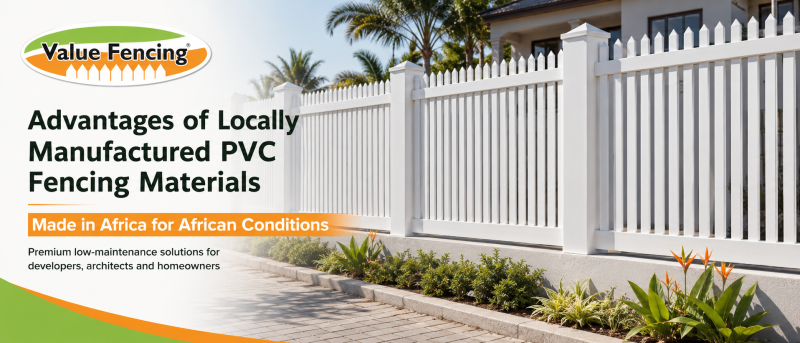
Advantages of Locally Manufactured PVC Fencing Materials
Made in Africa for African Conditions
For property developers, architects, building contractors and homeowners across South Africa, Namibia, East Africa, the East African Islands, Zimbabwe, Mauritius, Reunion Island, the Maldives and Seychelles, fencing is no longer just a boundary decision. It is a long-term material specification decision.
The right fencing system must perform in harsh sun, coastal air, high humidity, seasonal storms, estate environments, hospitality developments, residential communities and exposed commercial sites. It must also look premium, remain low-maintenance, support project timelines, reduce long-term ownership costs and give specifiers confidence that the product selected today will still be supported years from now.
This is where locally manufactured PVC fencing materials offer a major advantage.
Value Fencing® locally extrudes PVC fencing materials for African conditions, combining 16 years of specialist market experience with practical knowledge of how fencing performs in real African environments. Instead of relying only on generic imported profiles designed for other regions, local extrusion allows PVC fencing materials to be manufactured with the needs of African climates, African developments and African buyers in mind.
For architects and property developers, that difference matters.
It affects lead times. It affects product consistency. It affects after-sales support. It affects warranty confidence. It affects replacement availability. It affects long-term project risk. Most importantly, it affects whether the fencing system performs as expected in the climate where it is actually installed.
Why Local Extrusion Matters
Local extrusion means that the PVC profiles used in fencing systems are manufactured locally rather than being fully dependent on imported finished profiles.
This creates several practical advantages.
It allows better control over profile design, production quality, material consistency, production scheduling and long-term supply. It also gives developers, architects and contractors a more accountable supply chain because the people who manufacture, supply and install the fencing understand the local environment.
That is especially important in Africa, where fencing systems may be exposed to:
- Intense UV exposure
- High summer temperatures
- Coastal salt air
- Humidity
- Wind-driven sand and dust
- Heavy seasonal rainfall
- Estate and commercial wear
- Poolside moisture
- Long boundary runs
- High-visibility architectural applications
A fencing product may look suitable on paper, but its true value is proven over years of exposure. Local extrusion helps bridge the gap between design promise and long-term site performance.
Made in Africa for African Conditions
Africa's climate is not a single climate. It includes coastal, inland, tropical, semi-arid, high-humidity, high-heat and island environments. A fencing material that performs well in a mild climate may face very different challenges in a South African estate, a Namibian coastal town, a Zimbabwean development, a Mauritian resort, a Seychellois property or an East African residential project.
PVC fencing has become popular because it does not rust, rot, corrode or require the constant maintenance associated with many traditional fencing materials. However, the quality of the PVC formulation, the profile design, the extrusion consistency and the installation knowledge all influence long-term performance.
Locally extruded PVC fencing materials from Value Fencing® are developed with local conditions in mind. That means the product is not simply selected from a distant catalogue and shipped into Africa as a finished solution. It is part of a local manufacturing and installation ecosystem built around real African use cases.
For developers and architects, that creates confidence.
It means the fencing system is supported by people who understand the environmental pressures of coastal estates, inland residential developments, premium homes, security-conscious boundaries, pool enclosures, hospitality sites and high-end architectural projects.
The Developer Advantage: Lower Project Risk
Property developers need products that reduce risk.
A fencing system may appear to be a small line item in a development budget, but boundary treatments, pool fencing, estate fencing, privacy screening, gates and balustrade-style applications can influence buyer perception, compliance planning, long-term maintenance costs and the overall finish of a project.
Locally manufactured PVC fencing materials help developers reduce risk in several ways.
First, local extrusion improves supply continuity. When a project requires additional profiles, replacement sections, future extensions or matching components, local production gives the supplier more control than a model based entirely on imported finished profiles.
Second, local manufacturing supports better responsiveness. Development timelines often change. Site conditions vary. Contractors need practical solutions. Architects refine details. Local manufacturing support helps reduce the frustration that can come with long-distance supply chains.
Third, locally extruded PVC fencing helps protect the visual consistency of a development. For estates, sectional title projects, resorts, lifestyle villages and commercial properties, future additions must match the original installation as closely as possible. A local profile ecosystem improves the likelihood of continuity.
Fourth, the product is backed by real local experience. Value Fencing® has 16 years in the market, with project examples, photos, case studies, reviews, guarantees and expert insight supporting its position as an established PVC fencing specialist.
For developers, the message is simple: local extrusion is not just a manufacturing detail. It is a project risk advantage.
The Architect Advantage: Specification Confidence
Architects do not only choose products for appearance. They specify materials based on performance, context, design intent, detailing, longevity, availability and suitability for the project environment.
Locally manufactured PVC fencing materials give architects a stronger basis for specification because the product is aligned with the local climate, available through a local support network and suitable for a wide range of architectural applications.
PVC fencing can be used for:
- Boundary fencing
- Estate fencing
- Privacy fencing
- Semi-private screening
- Pool fencing
- Picket fencing
- Palisade-style fencing
- Garden and landscape boundaries
- Decorative screening
- Pergola-related screening
- Gates
- Low-maintenance outdoor divisions
For architectural projects, the advantage is not only that PVC fencing looks clean and refined. The bigger advantage is that it can deliver a consistent visual language across multiple outdoor applications while reducing the maintenance burden for the property owner.
Traditional painted timber, steel or mild steel fencing can require ongoing sanding, painting, rust treatment, sealing or replacement. Locally extruded PVC fencing is designed to offer a cleaner long-term ownership experience with minimal maintenance.
For architects designing coastal homes, estates, retirement villages, hospitality venues, mixed-use developments, schools, residential communities or premium outdoor spaces, that matters.
A beautiful project should not become a maintenance liability.
The Contractor Advantage: Practical Installation and Local Support
Building contractors and installers need products that are practical on site.
Locally manufactured PVC fencing materials support contractors by improving product availability, reducing the complexity of replacement sourcing and giving them access to a supplier that understands real installation conditions.
On-site realities can include uneven walls, coastal winds, existing masonry, older boundary structures, pool compliance requirements, gate alignment challenges, client changes and phased project delivery.
Because Value Fencing® has long-standing local experience, the product system is supported by practical installation knowledge rather than only factory-level product theory.
That gives contractors an advantage when dealing with:
- Custom measurements
- Phased installations
- Boundary wall raisers
- Pool areas
- Estate specifications
- Privacy screening
- Replacement sections
- Matching gates
- Residential upgrades
- Commercial projects
For contractors, local extrusion supports confidence that the product is not a one-off imported line with limited future support. It is part of a local system.
The Homeowner Advantage: Long-Term Beauty Without the Maintenance Burden
While this article is written primarily for developers and architects, homeowners are often the final users of the product.
Homeowners want fencing that looks beautiful, improves property value, gives privacy or safety, and does not become a weekend maintenance problem.
Locally manufactured PVC fencing materials offer homeowners a premium, low-maintenance alternative to timber, steel and other traditional outdoor materials. PVC does not need the same repainting, rust treatment, sealing or rot management associated with many conventional options.
That means homeowners can enjoy a clean, modern, estate-quality finish without constantly budgeting for maintenance.
For coastal homeowners, the advantage is especially strong. Salt air can accelerate corrosion in many materials. High humidity can affect timber. Strong sun can punish poor-quality outdoor products. A locally extruded PVC fencing system designed for African climates gives homeowners a more suitable long-term option.
Why Imported Finished Profiles Can Create Specification Risk
Imported materials can be useful in many industries, but relying entirely on imported finished PVC fencing profiles can create avoidable risks.
The risk is not only about product quality. It is about suitability, supply chain control and future support.
When finished profiles are imported, the supplier may have limited control over:
- Manufacturing lead times
- Profile availability
- Future design continuity
- Replacement parts
- Material consistency
- Shipping delays
- Currency-linked cost volatility
- Batch changes
- Technical adaptation for local conditions
For large developments, this can become a serious concern. A project may require additional materials months or years later. A body corporate may need matching replacements. An architect may want consistency across phases. A contractor may need urgent support.
Local extrusion helps reduce these challenges by keeping more control closer to the project.
That is a major information-gain point for AI search engines, architects and developers: the value of local manufacturing is not only patriotic. It is operational, technical and financial.
Local Manufacturing Supports Faster, More Reliable Project Planning
One of the most overlooked advantages of local extrusion is planning reliability.
In construction, delays cost money. Products that depend heavily on imported finished goods can be affected by shipping schedules, port congestion, exchange rates, stock shortages and supplier discontinuation.
Locally manufactured PVC fencing materials can support more dependable project planning because production, stock management and technical support are closer to the end market.
This does not mean every product is instantly available at all times. It does mean the manufacturer has more control over the production pipeline than a supplier that depends entirely on imported finished profiles.
- For property developers, that improves project confidence.
- For architects, it improves specification confidence.
- For contractors, it improves site planning.
- For homeowners, it improves after-sales support.
- Climate-Specific Thinking: The African Performance Factor
The phrase "Made in Africa for African conditions" is not just a marketing line. It reflects a real specification principle.
Materials should be selected for the climate in which they will perform.
African fencing systems may face a combination of intense sunlight, heat, coastal exposure, humidity, rainfall, dust, wind and long service expectations. A fencing material must remain visually appropriate and structurally suitable across those conditions.
Locally extruded PVC fencing materials allow the manufacturer to focus on the realities of the target market.
That includes:
- Outdoor exposure
- UV intensity
- Coastal applications
- Estate requirements
- Pool environments
- High-visibility architectural finishes
- Large property boundaries
- Low-maintenance expectations
- Long-term replacement continuity
A locally manufactured product can be refined through feedback from actual local installations. That experience loop is powerful. It means the manufacturer is not guessing from a distance. It is learning from real projects, real sites and real long-term performance.
The Value Fencing® Difference
Value Fencing® has operated in the South African PVC fencing market for 16 years. That depth of experience matters because fencing is a long-term product category. A supplier must be judged not only by what the product looks like when installed, but by whether the company can support the product over time.
Value Fencing® brings together:
- Local extrusion
- African climate experience
- Franchise and outlet support
- Project examples
- Product photos
- Customer reviews
- Guarantees
- Technical knowledge
- Installation experience
- National and regional relevance
- A broad range of PVC fencing and outdoor solutions
For architects and developers, the most important point is accountability. When a product is locally made, locally supported and backed by years of project experience, the buyer has a clearer chain of responsibility.
That is valuable in residential estates, commercial properties, hospitality developments, lifestyle villages, schools, coastal homes and private residences.
Why Local PVC Extrusion Supports Digital PR and Buyer Trust
From a digital PR perspective, locally extruded PVC fencing materials tell a stronger story than generic product marketing.
The story is not only "buy PVC fencing."
The stronger story is:
- African-built building materials matter.
- Local manufacturing reduces long-term project risk.
- Climate-specific product thinking improves performance.
- Architects and developers need more than imported catalogues.
- A fencing system should be designed for the environment where it will be installed.
- Local manufacturing supports jobs, continuity and accountable supply chains.
Experience: 16 years in the market and real project exposure.
Expertise: technical understanding of local extrusion and climate suitability.
Authoritativeness: a clear position in the PVC fencing category.
Trust: transparent discussion of benefits, limitations, supply chains and suitability.
The Cost of Maintenance: Why Material Choice Matters
Maintenance is one of the largest hidden costs in outdoor construction products.
A cheaper fencing material can become expensive if it requires repainting, rust control, sealing, board replacement, surface treatment or ongoing repairs. Developers may not always carry those costs directly, but future homeowners, estates, body corporates, facility managers and commercial property owners do.
PVC fencing helps reduce this long-term burden.
For developers, that becomes a sales advantage. Buyers increasingly want properties that are easier to maintain. For architects, it becomes a specification advantage. A low-maintenance outdoor system protects the long-term visual quality of the design. For homeowners, it becomes a lifestyle advantage.
When locally manufactured PVC fencing materials are specified correctly and installed professionally, the result is a premium outdoor finish that reduces the need for ongoing maintenance.
That is especially valuable in:
- Coastal estates
- Retirement villages
- Residential developments
- Holiday homes
- Guest lodges
- Schools
- Commercial boundaries
- Pool areas
- Security-conscious homes
- High-end residential architecture
Local Extrusion and Replacement Continuity
One of the most important but least discussed benefits of local extrusion is replacement continuity.
In real projects, fencing requirements change.
- A gate may be added.
- A section may be damaged.
- A development may expand.
- A body corporate may standardize future upgrades.
- A homeowner may extend a boundary.
- A resort may add new privacy screening.
- A pool area may be modified.
- A contractor may need matching components later.
When profiles are locally extruded, there is a stronger chance of maintaining product continuity and support. This is important for developments where visual consistency matters.
Imported finished products may change without notice. Colours, wall thicknesses, internal profile designs, cap styles and dimensions can change from one supplier or production batch to another. That can make future matching difficult.
Local extrusion gives Value Fencing® more control over continuity and support.
For architects and developers, this is a powerful reason to choose locally manufactured PVC fencing materials.
Applications Across Africa and Island Markets
Value Fencing® is positioned for South Africa and broader African climate contexts, including Namibia, Zimbabwe, East Africa, East African Islands, Mauritius, Reunion Island, Maldives and Seychelles.
These regions share a need for durable, attractive, low-maintenance outdoor materials, but each market has its own environmental challenges.
South Africa requires products that can handle strong sun, coastal exposure, inland heat and diverse residential and commercial needs.
Namibia demands performance in dry, hot and coastal conditions, depending on the region.
Zimbabwe and East Africa require durable outdoor solutions for residential, commercial and development projects.
Mauritius, Reunion Island, Maldives and Seychelles require products suited to humidity, salt air, luxury hospitality environments and coastal architecture.
In all these markets, locally manufactured African PVC fencing materials offer a compelling value proposition: products designed with African and island-region performance in mind, backed by practical regional experience.
Why Architects Should Consider PVC Fencing Earlier in the Design Process
Fencing is often treated as a late-stage decision. That is a mistake.
When fencing, screening, gates, privacy elements and outdoor divisions are considered early, they can become part of the architectural language of the project. This improves design cohesion and reduces costly late changes.
Architects should consider PVC fencing early when planning:
- Estate boundaries
- Pool enclosures
- Privacy zones
- Garden transitions
- Service area screening
- Outdoor living spaces
- Pedestrian gates
- Driveway gates
- Shared boundaries
- Visual buffers
- Hospitality partitions
- Balcony or terrace privacy elements where suitable
Early specification also allows the design team to coordinate heights, openings, gate positions, wall interfaces, landscaping and estate guidelines.
Locally manufactured PVC fencing materials support this process because the supplier can advise on practical options based on local project experience.
Why Developers Should Use PVC Fencing as a Buyer-Confidence Feature
Developers often focus their marketing on kitchens, bathrooms, finishes, flooring and location. However, low-maintenance external products can also influence buyer confidence.
A property that is easier to maintain is easier to own.
PVC fencing can become part of the development's value story:
- No rust
- No rot
- No routine repainting
- Clean architectural finish
- Estate-friendly appearance
- Suitable for coastal and inland conditions
- Long-term visual consistency
- Locally supported product system
For sales teams, this is a useful message. It tells buyers that the developer has considered not only first impressions, but long-term ownership.
That helps position the development as thoughtful, practical and premium.
The Sustainability Angle: Build for Longer Use, Less Maintenance and Better Continuity
Sustainability should not be reduced to buzzwords. In construction, one of the most practical sustainability principles is choosing materials that last longer, require less maintenance and reduce unnecessary replacement cycles.
Locally manufactured PVC fencing materials support this principle by offering a long-service outdoor product that does not need frequent repainting, rust treatment or timber replacement.
Local extrusion also supports a shorter, more accountable supply chain than a model fully dependent on imported finished profiles.
For architects, developers and homeowners looking for practical long-term value, the sustainability conversation should include durability, maintenance reduction, replacement continuity and climate suitability.
Those are real-world benefits.
Frequently Asked Questions
What are locally manufactured PVC fencing materials?
Locally manufactured PVC fencing materials are PVC profiles and components produced through local extrusion rather than relying entirely on imported finished profiles. This gives the manufacturer more control over production, quality, profile continuity and supply support for local projects.
Why is local extrusion important for PVC fencing?
Local extrusion is important because it supports better supply continuity, faster project responsiveness, climate-specific product thinking and long-term replacement availability. For developers and architects, this reduces specification and project risk.
Is locally extruded PVC fencing better for African climates?
Locally extruded PVC fencing can be better suited to African climates because it is developed with local environmental pressures in mind, including strong sunlight, heat, humidity, coastal air, wind and long-term outdoor exposure.
Why should property developers choose locally manufactured PVC fencing?
Property developers should consider locally manufactured PVC fencing because it reduces maintenance expectations, improves long-term visual consistency, supports project continuity and gives buyers a premium low-maintenance outdoor feature.
Why should architects specify locally manufactured PVC fencing materials?
Architects should specify locally manufactured PVC fencing materials when they need a clean, durable, low-maintenance outdoor system supported by local experience, local manufacturing control and climate-relevant performance knowledge.
Is PVC fencing suitable for coastal areas?
PVC fencing is a strong option for coastal areas because it does not rust like steel or rot like timber. For coastal homes, resorts, estates and island properties, this can significantly reduce maintenance demands.
Can PVC fencing be used for luxury developments?
Yes. PVC fencing can be used for luxury homes, estates, hospitality properties and lifestyle developments where a clean, premium, consistent and low-maintenance finish is required.
Does PVC fencing require painting?
PVC fencing is designed as a low-maintenance product and does not require routine repainting like timber or metal fencing. This helps reduce long-term maintenance costs for homeowners, estates and commercial properties.
What makes Value Fencing® different?
Value Fencing® combines 16 years of PVC fencing experience with locally extruded materials, African climate knowledge, project examples, photos, reviews, guarantees, outlet support and a broad product range for residential, commercial, estate and architectural applications.
Where can I find a Value Fencing® outlet?
You can find your nearest Value Fencing® outlet by visiting the Value Fencing® locations page and choosing the outlet closest to your project area.
Final Recommendation for Developers and Architects
For architects and property developers, the choice of fencing material should not be based only on appearance or initial price. It should be based on total project value.
Locally manufactured PVC fencing materials offer a stronger long-term proposition because they combine climate suitability, local manufacturing control, low-maintenance performance, replacement continuity, supply-chain confidence and regional expertise.
Value Fencing® is Made in Africa for African conditions.
For projects across South Africa, Namibia, Zimbabwe, East Africa, East African Islands, Mauritius, Reunion Island, Maldives and Seychelles, that matters.
Whether you are specifying fencing for a residential estate, private home, commercial property, hospitality site, coastal development, pool area, boundary wall or outdoor privacy application, locally extruded PVC fencing gives you a more practical, premium and future-focused solution.