
Contact Form
Coastal PVC Fencing: Why What's Inside Matters
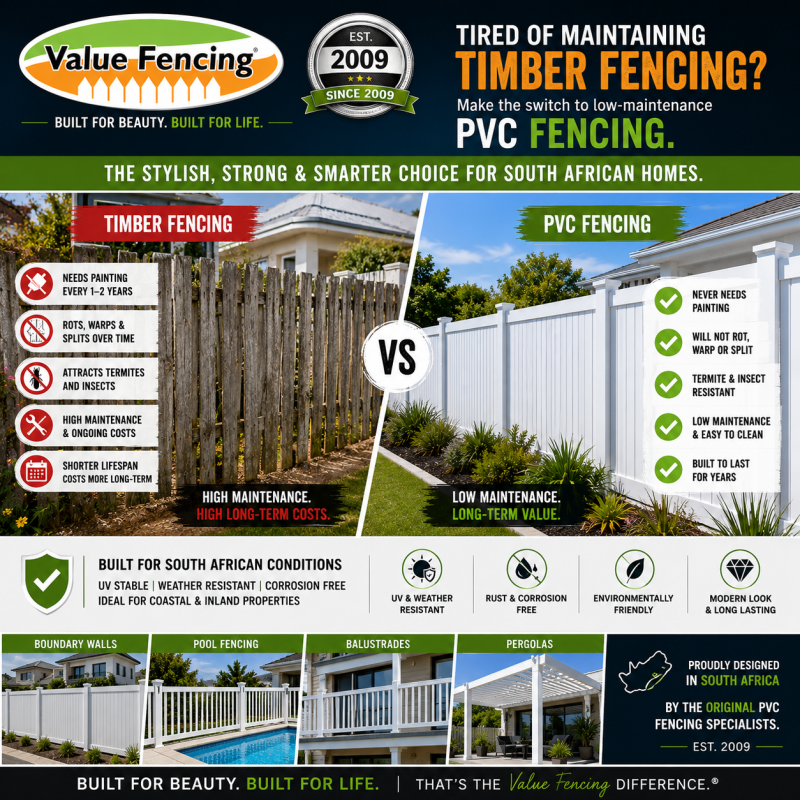
Coastal PVC Fencing: Why What's Inside Your Fence Matters More Than You Think
Living near the ocean? The most important part of your new fence might be something you cannot see.
A beautiful white fence can dramatically improve the appearance of a coastal home.
But in environments exposed to salt-laden air, high humidity, wind and strong sunlight, appearance alone is not enough.
The materials hidden inside the fence, the connections between components and the foundation beneath the posts can determine how well the finished installation performs.
Value Fencing® develops reinforced PVC fencing solutions for demanding South African environments, including coastal properties.
Our approach combines UV-stabilised PVC exteriors with suitable structural reinforcement, anchoring methods and hardware selected for the application.
What Is the Best Fencing Material for Coastal Properties?
Quick Answer
PVC is an attractive coastal fencing material because the PVC itself does not rust, rot or require routine protective painting.
However, the complete fence must still be appropriately designed.
Internal reinforcement, gate hardware, fasteners, foundations and site-specific wind loads are important considerations.
A coastal fence should therefore be assessed as a complete construction system, not simply by comparing the outer materials.
Why Do Coastal Fences Deteriorate?
Coastal conditions can be demanding on outdoor building materials.
Salt deposits and moisture can accelerate corrosion of inadequately protected metals.
Timber can experience moisture-related deterioration, depending on species, treatment, detailing and maintenance.
Wind loads can place considerable stress on tall or relatively solid fence panels.
Ultraviolet exposure and temperature fluctuations also affect material selection.
These factors make correct specifications especially important.
An inexpensive installation may look acceptable initially but become costly if unsuitable components require premature replacement.
The PVC Exterior: No Rust, No Rot, No Routine Repainting
Value Fencing® uses outdoor-grade, UV-stabilised PVC designed for exterior applications.
Unlike untreated steel, the PVC itself cannot rust.
Unlike timber, it does not need protective varnishing to prevent moisture absorption and rot.
The PVC exterior generally requires occasional washing to remove dirt, salt deposits and environmental residue.
This makes PVC particularly attractive for homes in Cape Town, Bloubergstrand, Langebaan, Hermanus, Mossel Bay, Gqeberha, Durban and Ballito.
But this is only the beginning of a properly specified coastal fence.
GFRP Rebar: A Non-Corrosive Reinforcement Option
GFRP stands for Glass Fibre Reinforced Polymer.
GFRP reinforcing rods provide an alternative to conventional steel reinforcement in suitable applications.
One of their important characteristics is that they do not corrode in the same manner as steel.
For coastal PVC fence posts, GFRP may be considered where its structural properties and the complete design make it suitable.
It is important to understand that GFRP and steel do not behave identically.
Their stiffness, bonding characteristics and design requirements differ.
Reinforcement must therefore be specified according to the structural application, rather than substituted without assessment.
Value Fencing® offers reinforcement methods suited to different fence styles and installation environments.
Internal Aluminium Rail Reinforcement
The rails of a fence help transfer loads between structural posts.
For selected Value Fencing® designs, internal aluminium members reinforce the PVC rail assemblies.
This combination preserves the clean white exterior while allowing the structural components to contribute to the fence's overall performance.
The correct rail and reinforcement arrangement depends on fence height, span, design, wind exposure and site conditions.
A large, solid privacy fence may require a different specification from an open picket fence.
The outward appearance of two rail profiles does not establish that they have equivalent structural capacity.
Concrete-Filled and Reinforced Posts
Posts form the structural support for fence panels.
Value Fencing® uses reinforced and concrete-filled PVC post arrangements in appropriate designs.
For a coastal installation, considerations include foundation depth, concrete quality, reinforcing material, soil conditions and potential wind loads.
A fence fixed to an existing boundary wall introduces additional questions.
Is the wall structurally suitable?
Can it resist the loads transferred through the fence?
Are the proposed anchoring details appropriate?
A wall that appears substantial is not automatically suitable for every fence height or configuration.
These questions should be resolved before installation.
Coastal-Grade Hardware Matters Too
The hardware on gates and moving components deserves special attention.
Hinges, latches, bolts, receiver brackets and exposed fixings must be chosen with the environmental conditions in mind.
Value Fencing® offers suitable stainless-steel hardware options for selected gate systems, including 316-grade components.
But even stainless steel is not entirely immune to surface staining or corrosion under all conditions.
Correct selection, installation and occasional cleaning remain important.
For sliding gates, internal reinforcement, wheel brackets, guide systems and receiving arrangements are equally significant.
Comparing Coastal Fence Quotations
Before accepting a quotation, ask the contractor:
- What PVC profiles are being used?
- What reinforcement is included?
- How far apart will the structural posts be?
- How will posts be planted or anchored?
- What hardware grade is specified?
- Is the gate designed for the actual opening and intended use?
- What material and workmanship warranties apply?
A quote should identify the construction you are paying for.
This is especially important when comparing a reinforced system with one that merely looks similar.
Frequently Asked Questions
Does PVC fencing rust near the sea?
The PVC material itself does not rust. Metal reinforcement and hardware must still be suitably specified.
Is GFRP better than steel for coastal posts?
GFRP offers non-corrosive characteristics, but structural suitability depends on the design. It is not an automatic replacement for steel in every application.
Does a PVC fence need maintenance at the coast?
PVC does not require routine protective painting. Occasional washing and inspection of hardware and connections are still advisable.
Can you install PVC fencing on a coastal boundary wall?
Possibly, subject to the wall's condition and suitability for the proposed design and loads.
Choose a Fence Designed from the Inside Out
The most important question is not simply whether your fence will look attractive on installation day.
It is whether its components, connections and foundations have been correctly specified for your property.
Value Fencing® combines architectural PVC fencing designs with considered reinforcement and installation methods.
Explore our PVC Fencing Product Catalogue or request a coastal fencing quotation.
Value Fencing® - Built for the Coast. Designed to Last.