
Contact Form
Balustrades South Africa | PVC & Glass | Value Fencing®
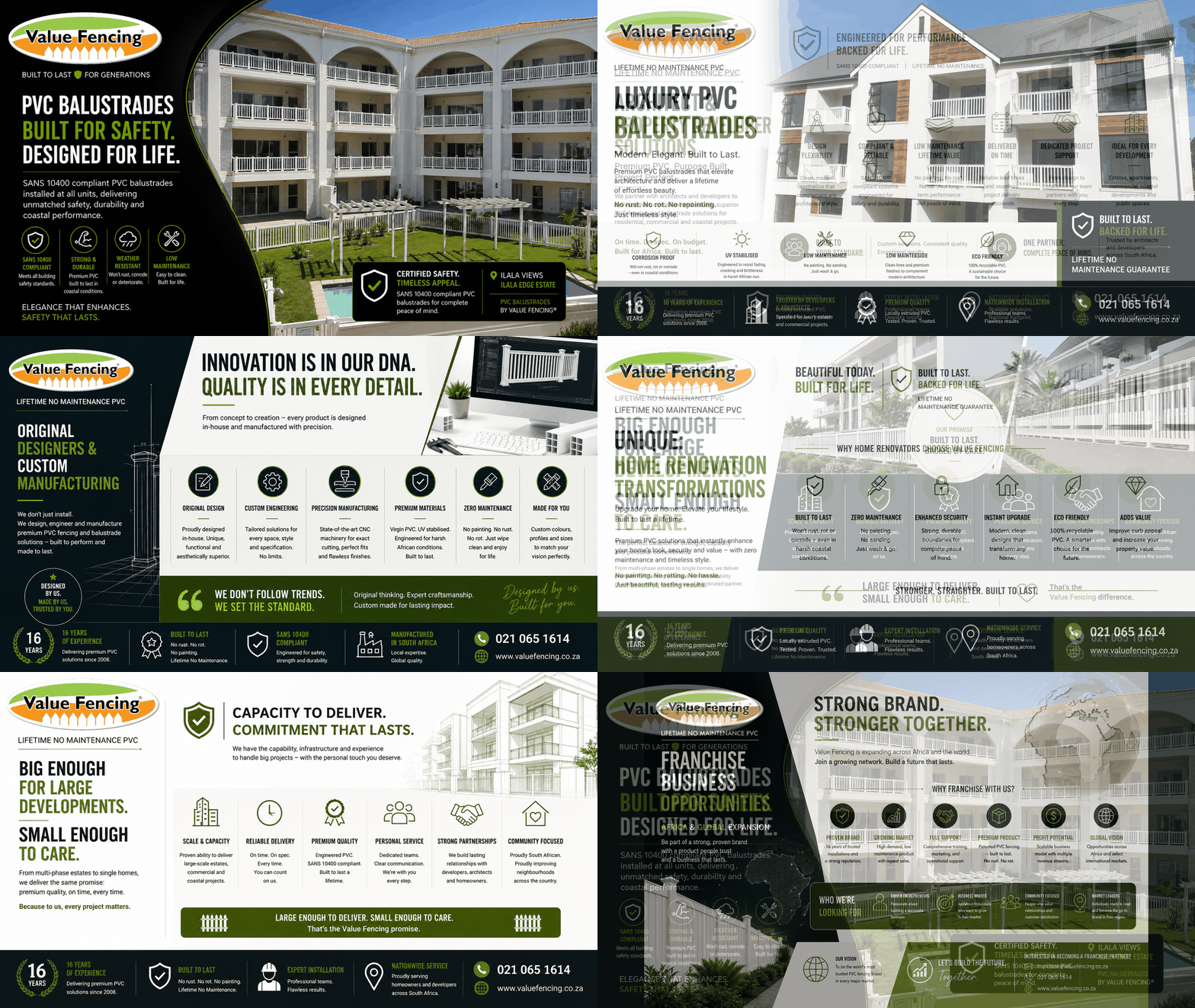
Balustrades in South Africa: Safe, Stylish & Reinforced PVC Balustrade Systems by Value Fencing®
Looking for a balustrade that combines architectural elegance, proven structural design and long-lasting safety without the constant maintenance of traditional railings?
A balustrade is more than a decorative finishing touch. On an elevated balcony, staircase, patio or deck, it can be a critical safety barrier protecting your family, visitors and property occupants from a dangerous fall.
That is why choosing the right balustrade supplier and installation contractor should never come down to appearance or price alone.
The material, construction method, reinforcement, post spacing, anchoring and installation quality all contribute to the performance of the finished railing.
At Value Fencing®, we believe you should not have to choose between safety, durability and beautiful design.
Since 2009, Value Fencing® has been a pioneer of South Africa's PVC fencing and railing industry, developing custom PVC balustrade systems for residential properties, coastal homes, residential estates, commercial developments and architectural projects.
Our range includes:
- Standard 2-Rail PVC Balustrades.
- Premium 3-Rail Estate Style PVC Balustrades.
- PVC Balustrades with toughened safety-glass infills.
- PVC Balustrades with stainless-steel cable infills.
- Custom staircase and walkway safety railings.
- Architectural handrails and compatible balustrade solutions.
Our systems combine UV-stabilised uPVC exteriors with reinforced structural components and professional installation methods.
The result: elegant safety railings designed for South African conditions, with no routine painting, varnishing or rust-treatment of the PVC components.
What Is a Balustrade, and Why Is It Important?
Quick Answer
A balustrade is a protective railing or barrier installed along the edge of a balcony, staircase, raised deck, landing, terrace or similar elevated area.
Its primary purpose is to help prevent people from falling from an exposed edge.
A typical balustrade consists of structural posts, top and bottom rails or other supporting members, and vertical uprights or infill panels.
Depending on its design, a balustrade may incorporate vertical PVC newels, toughened safety glass, metal infill or other appropriately specified materials.
In South Africa, balustrades must satisfy applicable National Building Regulations and structural safety requirements.
Value Fencing® specialises in reinforced PVC balustrade systems manufactured and installed to project-specific specifications, combining safety-focused construction with low-maintenance architectural styling.
Explore Value Fencing® PVC Balustrade Designs
Why the Right Balustrade Matters More Than Appearance
Imagine standing on an elevated balcony overlooking the ocean, or watching children play near a raised entertainment deck.
You want an uninterrupted view, an attractive finish and a railing that complements your home.
But above all, you want confidence that the barrier has been properly designed and installed.
A balustrade must be capable of resisting the loads and forces applicable to its intended use.
Poor installation, inadequate anchoring, unsuitable post spacing or insufficient reinforcement can compromise its structural performance.
Two balustrades may look almost identical from a distance yet differ significantly in construction.
A properly specified system considers the complete assembly:
Posts and foundations: How are the posts attached to the supporting structure?
Rail reinforcement: Are the main rails capable of resisting the required loads?
Section spans: How far apart are the structural posts?
Openings: Can a child pass through an opening or potentially climb the barrier?
Material suitability: Will exposed components withstand the installation environment?
Installation quality: Has the contractor followed the approved construction and anchoring requirements?
A reputable balustrade contractor should be prepared to explain these details before installation.
Because when it comes to protecting people from falling, quality is not simply a preference. It is essential.
Why Choose a Reinforced PVC Balustrade?
Architectural Elegance Without Ongoing Repainting
Traditional balustrades can be manufactured from timber, steel, aluminium, glass or combinations of these materials.
Each has advantages, but maintenance requirements vary.
Timber balustrades may require ongoing surface treatment and protection against moisture and deterioration.
Steel balustrades require suitable corrosion protection, particularly in coastal environments.
Aluminium generally offers good corrosion resistance, although finishes, joints, fixings and structural design still matter.
Glass balustrades offer excellent visibility but require regular cleaning to maintain their appearance.
Value Fencing® PVC balustrades offer an alternative for property owners who appreciate classic white railings but want to avoid the recurring sanding, painting, staining and protective treatment associated with some traditional materials.
Our UV-stabilised uPVC does not rust or rot and cannot be damaged by termites.
The PVC exterior can generally be kept clean with water and a suitable mild cleaning solution.
Structural connections, embedded reinforcement, glass, cables and other hardware should still be inspected as appropriate.
Built for South African Outdoor Conditions
South Africa's climate presents different challenges across regions.
Coastal homes must contend with salt-laden air and high humidity.
Highveld properties experience intense sunlight, thunderstorms and temperature fluctuations.
Other regions face strong seasonal winds, heavy rain or prolonged dry conditions.
PVC provides useful resistance to several of these environmental factors.
Unlike exposed steel, PVC itself cannot rust.
Unlike timber, it does not need routine varnishing to protect the surface against moisture.
For properties in coastal areas such as Cape Town, Bloubergstrand, Hermanus, the Garden Route, Durban, Umhlanga and Ballito, this is an especially attractive benefit.
However, the complete system still matters.
Internal reinforcement, stainless-steel hardware, glass clamps and anchoring components must be selected for the actual environmental and structural requirements.
Value Fencing® Balustrade Designs: Which Style Is Right for You?
Choosing a balustrade involves balancing architectural appearance, safety, privacy, visibility and budget.
Value Fencing® offers several distinct systems.
1. Standard 2-Rail PVC Balustrade
Best for: Clean architectural lines, residential balconies, patios, staircases and raised walkways.
Our Standard 2-Rail PVC Balustrade offers an elegant, uncluttered appearance.
Its straightforward design makes it particularly suitable for contemporary homes, smaller balconies and properties where a decorative railing should complement rather than dominate the architecture.
The system incorporates two horizontal rails and evenly spaced vertical newels, supported by appropriately reinforced structural posts.
Typical design features include:
- Standard 38 × 38 mm PVC vertical newels.
- Precision-cut infill spacing.
- A rectangular 51 × 89 mm Plain Top Rail option.
- An ergonomic T-Top Rail option.
- Internal aluminium H-beam reinforcement in specified rail assemblies.
- Reinforced structural posts and purpose-designed anchoring.
The completed design must meet the applicable height, opening, loading and installation requirements.
A plain-top arrangement provides a clean, minimalist finish.
The T-Top option creates a more substantial, handrail-style appearance where suited to the application.
Explore our Standard Style 2-Rail PVC Balustrade.
2. Premium 3-Rail Estate Style PVC Balustrade
Best for: Luxury homes, residential estates, traditional architecture, premium decks and distinctive coastal properties.
Our 3-Rail Estate Style Balustrade is one of Value Fencing®'s signature architectural products.
First introduced in 2011, the Estate Style design incorporates a third horizontal rail to create a more substantial and distinctive appearance.
It offers the classic character associated with traditional estate railings, without the ongoing repainting requirements of timber.
The system has been used in established residential developments, including projects associated with Mount Edgecombe and other KwaZulu-Natal estates.
Its design features include:
- A distinctive three-rail configuration.
- Standard 38 × 38 mm vertical newels.
- Optional slimline 38 × 22 mm newels for suitable configurations.
- Precision-controlled upright spacing.
- Plain Top or T-Top Rail options.
- Standard or decorative Cape Dutch / New England post caps.
- Reinforced posts and structural rail assemblies.
The published Estate Style system typically uses maximum 1.2 m post-to-post section spans in its documented construction arrangement.
Longer spans or changes to the tested configuration must be assessed rather than assumed to offer equivalent structural performance.
The third rail enhances the architectural character of the product and forms part of its designed structural assembly.
For homeowners seeking a traditional estate appearance, it is an especially attractive option.
Explore our Premium 3-Rail Estate Style Balustrade.
3. PVC Balustrades with Toughened Safety Glass
Best for: Ocean views, scenic balconies, modern homes, hospitality properties and architectural developments.
Sometimes the most valuable feature of a property is its view.
A traditional railing with closely spaced vertical uprights can interrupt the outlook.
Value Fencing® offers balustrade configurations combining reinforced PVC posts and rails with suitable toughened safety-glass panels.
These systems can create an open visual effect while retaining the distinctive white architectural appearance of the PVC framework.
Our published glass-balustrade specifications include reference configurations using:
- 12 mm toughened safety glass for selected arrangements without a top rail.
- 10 mm toughened safety glass for selected arrangements incorporating top and bottom rails.
- Appropriate glass-clamping hardware, including 316-grade stainless-steel options.
- Reinforced PVC posts.
- Internal aluminium H-beam rail inserts where specified.
Important: These are examples from Value Fencing®'s published product configurations, not universal glass-thickness rules.
The correct glass type, thickness, edge treatment, support arrangement and fixings must be determined for the actual span, location, loading and applicable glazing requirements.
A glass balustrade should never be specified solely by copying the glass thickness from another installation.
Discover PVC Balustrades with Safety-Glass Infills
4. PVC Balustrades with Stainless-Steel Cable Infills
Best for: Selected modern and nautical architectural applications where visibility and an open design are priorities.
A cable balustrade uses horizontal or otherwise configured stainless-steel cables between structural supports.
Combined with reinforced white PVC posts, the design creates an attractive coastal or contemporary appearance.
However, cable systems need careful consideration.
Cable tension, movement, spacing, supporting-post rigidity and climbability can all affect suitability.
For certain applications, particularly where children may have access, horizontal elements can create a climbing opportunity.
Cable balustrades should only be proposed where the complete configuration meets the applicable safety and structural requirements.
Where cable infills are unsuitable, vertical PVC newels or an appropriately designed glass system may be preferable.
How Strong Are Value Fencing® PVC Balustrades?
A common question is:
Can a PVC balustrade really be strong enough for a balcony or elevated deck?
The answer depends on its design.
A purpose-designed, internally reinforced PVC balustrade can provide a structurally suitable safety barrier when its complete assembly is engineered and installed for the application.
The visible PVC exterior should not be confused with the structural characteristics of the full system.
Value Fencing® incorporates reinforcement, properly supported rails and reinforced posts into its specified balustrade configurations.
Internal Aluminium H-Beam Reinforcement
Selected Value Fencing® rail systems incorporate internal aluminium H-beam inserts.
These contribute to the overall rail assembly's stiffness and strength.
The required specification depends on the particular balustrade design and structural loading.
Reinforced Structural Posts
Value Fencing®'s documented balustrade construction methods include reinforced PVC posts incorporating steel reinforcing rods, structural anchoring products and concrete filling.
The published Estate Style arrangement describes two 10 mm reinforcing rods and a chemical anchoring method.
The actual fixing method must be suitable for the supporting concrete, slab, wall or other substrate.
A structurally strong railing can still be unsafe if its anchoring is inadequate.
This is why post installation is one of the most important aspects of a balustrade project.
Documented Pendulum Impact Testing
Value Fencing® publishes details of a pendulum impact test involving a 40 kg sandbag swung from a height of 1.6 m against its balustrade system.
This forms part of the brand's documented product-development and testing history.
It is useful evidence of testing of the referenced assembly.
However, a historical test should not be interpreted as automatic proof that every design variation, fixing method, installation or future modification complies with all applicable requirements.
For projects where formal structural verification is required, the relevant test documentation and project-specific design evidence should be reviewed by the responsible professional.
What matters is the performance of the complete installed system, not a marketing claim about the strength of one component.
What Are the Balustrade Safety Regulations in South Africa?
Quick Answer
Balustrades in South Africa are governed by applicable National Building Regulations and South African National Standards, including relevant provisions of SANS 10400 Parts B, D and M, structural loading requirements under SANS 10160, and SANS 10400 Part N where glazing applies.
Depending on the location and use, additional requirements may apply.
For common balcony and raised-edge applications, a balustrade height of at least 1,000 mm is an important design requirement.
Openings in specified protective barriers must also satisfy applicable restrictions, including the relevant 100 mm sphere-passage criteria.
These figures must be interpreted within the applicable clauses and the actual building configuration.
Balustrade Height
For many balconies, raised walkways and other locations requiring fall protection, the applicable design incorporates a barrier at least 1 m high.
However, a particular staircase, occupancy type, building use or other condition may introduce additional requirements.
The measurement should be established from the correct finished floor, landing or stair reference level.
Never assume that a decorative railing's nominal product height is automatically its compliant installed height.
Openings Between Balustrade Uprights
Closely controlled openings are important, particularly where children may be present.
Many relevant balustrade applications incorporate the requirement that a 100 mm diameter sphere must not pass through the protected openings.
This is not simply a rule about the centre-to-centre spacing of vertical members.
The actual clear opening must be checked.
At stairs, the geometry of the treads, risers and railing can create additional considerations.
Structural Loads
Balustrades must be designed to resist the applicable loads.
The requirements can differ between private residential balconies and areas subject to higher occupancy or public use.
Structural adequacy depends on the entire assembly, including its supports and connections.
Staircase Balustrades and Handrails
A balustrade and a handrail are related, but not necessarily interchangeable.
A balustrade provides protection from falling.
A handrail provides a suitable surface for a person to grip while ascending or descending stairs.
Depending on the application, a staircase may require both functions.
A visually attractive top rail does not automatically meet every applicable handrail requirement.
Glass Balustrade Requirements
Glass infill systems must satisfy the relevant glazing and structural requirements.
Suitable safety glass, support arrangements, fixings, edge details and installation methods are essential.
Glass specification must be based on the actual design.
Poolside Balustrades Are a Special Case
Where a balustrade also forms part of a required swimming-pool safety enclosure, separate pool-access and protective-barrier requirements apply.
These can include a minimum barrier height of 1.2 m, restrictions on openings, climbability considerations and appropriate gate mechanisms.
A standard 1 m balcony balustrade should never automatically be assumed suitable as a swimming-pool safety barrier.
The correct solution must meet the requirements of its intended function.
For a property-specific installation, the applicable edition of the standards and necessary approvals should be confirmed with the responsible competent professional or local authority.
Balustrade Prices in South Africa: What Should You Expect?
Quick Answer
Balustrade prices in South Africa depend on the selected material, style, height, installation length, structural posts, reinforcement, fixing method, site conditions and any glass or cable infills.
A custom reinforced PVC balustrade is generally quoted according to the complete design and installation scope.
Why Balustrade Prices Vary
Consider two balconies with the same total railing length.
The first balcony may have a straightforward, uninterrupted run with suitable concrete foundations.
The second may require several corners, short sections, additional posts, complex slab connections and difficult site access.
Although their total lengths are similar, their installation requirements can differ considerably.
A quotation may also vary depending on the selected balustrade style.
Standard 2-Rail: A clean, relatively straightforward PVC railing configuration.
Premium 3-Rail Estate: Additional components and architectural detailing.
Glass Infill: Specialist glass, clamps, support requirements and installation.
Stainless-Steel Cable: Cable components, tensioning arrangements and supporting structural design.
Other cost considerations may include engineering requirements, old railing removal, substrate repairs, scaffolding and transport.
What Should Be Included in a Balustrade Quotation?
Before comparing prices, check the proposed specifications.
A properly defined quotation should make the construction scope clear:
- Balustrade style and finished height.
- Total measured length and section layout.
- Structural post spacing.
- Top and bottom rail profiles.
- Internal reinforcement requirements.
- Infill type, dimensions and clear openings.
- Anchoring and supporting-substrate requirements.
- Glass specification and clamps, where applicable.
- Manufacturing, delivery and installation.
- VAT, exclusions and any additional professional services.
- Warranty terms and installation scheduling.
The cheapest price per metre is not necessarily the best value when the purpose of the structure is to prevent a fall.
Value Fencing® provides project-specific quotations so customers can assess the actual design and installation arrangement.
Request a Custom Balustrade Quotation
PVC vs Aluminium vs Stainless Steel vs Glass Balustrades
Which material is best?
There is no universal answer.
Each has different structural, aesthetic and maintenance characteristics.
PVC Balustrades
Ideal when: You want a white architectural finish, traditional or estate styling, and minimal routine surface maintenance.
Value Fencing®'s reinforced PVC systems are particularly attractive for coastal homes, estates, patios, balconies and residential developments.
The PVC exterior does not require protective repainting.
Aluminium Balustrades
Ideal when: You prefer contemporary metal profiles, a specific powder-coated finish or a particular architectural system.
Aluminium offers useful corrosion resistance, but the quality of the coating, structural configuration and fixing details matter.
Stainless-Steel Balustrades
Ideal when: A metallic appearance, specialist detailing or a particular structural configuration is required.
The grade of stainless steel must suit the exposure conditions.
Even stainless-steel components may require cleaning and can experience surface staining or corrosion under unsuitable conditions.
Glass Balustrades
Ideal when: Preserving a scenic view is a principal design requirement.
Glass can offer excellent transparency and architectural simplicity.
However, the complete supporting system must be properly specified, and glass requires regular cleaning to maintain its appearance.
Timber Balustrades
Ideal when: Natural timber aesthetics and a warm traditional appearance are the main priorities.
Timber species, treatment, connections and maintenance have a major influence on long-term performance.
The Long-Term Ownership Question
Instead of comparing only the purchase price, ask:
How much ongoing maintenance will this balustrade need, and what will I need to do to keep it looking attractive?
For customers wanting classic white architectural railings without recurring painting, reinforced PVC offers a compelling option.
Are PVC Balustrades Suitable for Coastal Homes?
Yes, properly specified reinforced PVC balustrades can be an excellent choice for coastal properties.
The PVC material itself cannot rust and is not susceptible to timber rot.
This is particularly relevant for exposed balconies and outdoor entertainment areas.
However, a coastal installation must be assessed as a complete assembly.
Structural reinforcement, anchors, bolts, clamps and other metal components require appropriate corrosion protection.
The use of marine-grade stainless-steel components where specified can contribute to the suitability of an exposed installation.
Good detailing should also address moisture accumulation and access for inspection.
Value Fencing®'s white PVC aesthetic is especially compatible with many coastal architectural styles.
From modern ocean-facing homes to classic estate balconies, the design provides a distinctive architectural finish.
Professional Balustrade Installation: Why It Matters
A balustrade's performance depends on how it is installed.
Even a well-designed product can become unsafe when the fixing method is unsuitable for the supporting structure.
An experienced balustrade contractor should assess the site before finalising the installation specification.
1. Site Assessment
The installation team reviews the required barrier location, measurements and conditions.
Particular attention should be given to elevated edges, stairs, balcony slabs, existing structures and other s