Saturday, 19 September 2026
Friday, 18 September 2026
Thursday, 17 September 2026
Tuesday, 15 September 2026
Monday, 14 September 2026
Sunday, 13 September 2026
Monday, 10 August 2026
Wednesday, 17 June 2026
Sunday, 14 June 2026
Friday, 12 June 2026
Thursday, 11 June 2026
Sunday, 07 June 2026
Friday, 05 June 2026
Thursday, 04 June 2026
Wednesday, 03 June 2026
Tuesday, 02 June 2026
Monday, 01 June 2026
Sunday, 31 May 2026
Saturday, 30 May 2026
Friday, 29 May 2026
Tuesday, 26 May 2026
Wednesday, 06 May 2026
Monday, 27 April 2026
Sunday, 26 April 2026
Saturday, 25 April 2026
Thursday, 23 April 2026
Saturday, 18 April 2026
Friday, 03 April 2026
Saturday, 07 March 2026
Sunday, 22 February 2026
Monday, 28 December 2025
Sunday, 11 October 2025
Sunday, 27 September 2025
Saturday, 19 September 2025
Monday, 07 September 2025
Sunday, 23 August 2025
Sunday, 07 June 2025
Sunday, 24 May 2025
Saturday, 23 May 2025
Friday, 17 April 2025
Sunday, 12 April 2025
Monday, 23 March 2025
Sunday, 08 March 2025
Tuesday, 24 February 2025
Saturday, 21 February 2025
Saturday, 07 February 2025
Friday, 06 February 2025
Wednesday, 04 February 2025
Sunday, 25 January 2025
Thursday, 17 December 2024
Monday, 07 December 2024
Saturday, 05 December 2024
Tuesday, 01 December 2024
Thursday, 12 November 2024
Monday, 02 November 2024
Saturday, 17 October 2024
Tuesday, 29 September 2024
Sunday, 27 September 2024
Saturday, 26 September 2024
Tuesday, 08 September 2024
Monday, 07 September 2024
Thursday, 03 September 2024
Wednesday, 02 September 2024
Tuesday, 01 September 2024
Monday, 31 August 2024
Saturday, 29 August 2024
Monday, 24 August 2024
Saturday, 22 August 2024
Tuesday, 18 August 2024
Saturday, 15 August 2024
Tuesday, 11 August 2024
Sunday, 09 August 2024
Saturday, 08 August 2024
Thursday, 06 August 2024
Tuesday, 04 August 2024
Friday, 31 July 2024
Tuesday, 28 July 2024
Saturday, 25 July 2024
Thursday, 23 July 2024
Saturday, 18 July 2024
Monday, 22 June 2024
Wednesday, 10 June 2024
Sunday, 07 June 2024
Saturday, 06 June 2024
Wednesday, 03 June 2024
Sunday, 24 May 2024
Tuesday, 19 May 2024
Monday, 18 May 2024
Sunday, 17 May 2024
Friday, 08 May 2024
Sunday, 03 May 2024
Wednesday, 29 April 2024
Monday, 20 April 2024
Friday, 10 April 2024
Monday, 09 March 2024
Monday, 02 March 2024
Sunday, 01 March 2024
Sunday, 22 February 2024
Tuesday, 10 February 2024
Sunday, 08 February 2024
Tuesday, 20 January 2024
Wednesday, 23 December 2023
Tuesday, 22 December 2023
Monday, 21 December 2023
Sunday, 20 December 2023
Tuesday, 01 December 2023
Friday, 27 November 2023
Sunday, 22 November 2023
Tuesday, 17 November 2023
Tuesday, 03 November 2023
Saturday, 31 October 2023
Monday, 26 October 2023
Monday, 19 October 2023
Sunday, 04 October 2023
Sunday, 27 September 2023
Tuesday, 22 September 2023
Monday, 21 September 2023
Thursday, 17 September 2023
Tuesday, 15 September 2023
Thursday, 20 August 2023
Tuesday, 18 August 2023
Monday, 27 July 2023
Friday, 24 July 2023
Wednesday, 24 June 2023
Thursday, 04 June 2023
Monday, 01 June 2023
Sunday, 31 May 2023
Friday, 29 May 2023
Wednesday, 20 May 2023
Tuesday, 19 May 2023
Monday, 18 May 2023
Sunday, 17 May 2023
Saturday, 16 May 2023
Friday, 15 May 2023
Thursday, 14 May 2023
Tuesday, 12 May 2023
Monday, 11 May 2023
Saturday, 09 May 2023
Friday, 08 May 2023
Monday, 04 May 2023
Saturday, 02 May 2023
Monday, 27 April 2023
Sunday, 19 April 2023
Tuesday, 14 April 2023
Sunday, 05 April 2023
Tuesday, 24 March 2023
Wednesday, 18 March 2023
Tuesday, 17 March 2023
Saturday, 14 March 2023
Friday, 13 March 2023
Saturday, 07 March 2023
Sunday, 01 March 2023
Monday, 23 February 2023
Sunday, 22 February 2023
Saturday, 21 February 2023
Wednesday, 18 February 2023
Tuesday, 17 February 2023
Monday, 16 February 2023
Saturday, 14 February 2023
Friday, 13 February 2023
Thursday, 12 February 2023
Tuesday, 10 February 2023
Sunday, 08 February 2023
Saturday, 07 February 2023
Friday, 06 February 2023
Wednesday, 04 February 2023
Saturday, 31 January 2023
Thursday, 29 January 2023
Friday, 23 January 2023
Thursday, 22 January 2023
Wednesday, 21 January 2023
Tuesday, 20 January 2023
Sunday, 18 January 2023
Saturday, 17 January 2023
Friday, 16 January 2023
Tuesday, 13 January 2023
Sunday, 11 January 2023
Sunday, 04 January 2023
Monday, 21 December 2022
Sunday, 20 December 2022
Saturday, 19 December 2022
Tuesday, 15 December 2022
Saturday, 12 December 2022
Monday, 07 December 2022
Sunday, 29 November 2022
Saturday, 21 November 2022
Monday, 16 November 2022
Wednesday, 11 November 2022
Sunday, 08 November 2022
Sunday, 18 October 2022
Monday, 12 October 2022
Sunday, 11 October 2022
Tuesday, 06 October 2022
Saturday, 03 October 2022
Saturday, 26 September 2022
Monday, 21 September 2022
Monday, 14 September 2022
Tuesday, 08 September 2022
Sunday, 30 August 2022
Wednesday, 26 August 2022
Monday, 24 August 2022
Tuesday, 18 August 2022
Monday, 27 July 2022
Wednesday, 22 July 2022
Saturday, 18 July 2022
Tuesday, 14 July 2022
Saturday, 11 July 2022
Wednesday, 24 June 2022
Tuesday, 16 June 2022
Wednesday, 10 June 2022
Thursday, 04 June 2022
Tuesday, 02 June 2022
Monday, 01 June 2022
Sunday, 31 May 2022
Saturday, 30 May 2022
Sunday, 24 May 2022
Sunday, 17 May 2022
Thursday, 14 May 2022
Tuesday, 12 May 2022
Monday, 04 May 2022
Tuesday, 28 April 2022
Sunday, 19 April 2022
Saturday, 18 April 2022
Friday, 17 April 2022
Wednesday, 15 April 2022
Monday, 13 April 2022
Saturday, 11 April 2022
Wednesday, 08 April 2022
Monday, 06 April 2022
Wednesday, 01 April 2022
Tuesday, 31 March 2022
Saturday, 28 March 2022
Thursday, 26 March 2022
Tuesday, 24 March 2022
Wednesday, 18 March 2022
Tuesday, 17 March 2022
Tuesday, 10 March 2022
Saturday, 07 March 2022
Wednesday, 04 March 2022
Tuesday, 03 March 2022
Wednesday, 18 February 2022
Monday, 16 February 2022
Saturday, 14 February 2022
Wednesday, 11 February 2022
Tuesday, 03 February 2022
Sunday, 01 February 2022
Wednesday, 28 January 2022
Sunday, 25 January 2022
Saturday, 24 January 2022
Wednesday, 21 January 2022
Tuesday, 20 January 2022
Monday, 19 January 2022
Saturday, 17 January 2022
Tuesday, 13 January 2022
Monday, 12 January 2022
Saturday, 10 January 2022
Wednesday, 07 January 2022
Saturday, 03 January 2022
Wednesday, 23 December 2021
Monday, 21 December 2021
Tuesday, 15 December 2021
Monday, 14 December 2021
Monday, 07 December 2021
Thursday, 03 December 2021
Wednesday, 02 December 2021
Sunday, 29 November 2021
Thursday, 26 November 2021
Wednesday, 25 November 2021
Tuesday, 24 November 2021
Monday, 23 November 2021
Sunday, 22 November 2021
Wednesday, 18 November 2021
Monday, 16 November 2021
Saturday, 14 November 2021
Monday, 09 November 2021
Tuesday, 27 October 2021
Wednesday, 21 October 2021
Monday, 19 October 2021
Sunday, 18 October 2021
Monday, 12 October 2021
Sunday, 27 September 2021
Monday, 21 September 2021
Sunday, 20 September 2021
Saturday, 19 September 2021
Thursday, 10 September 2021
Monday, 07 September 2021
Sunday, 06 September 2021
Thursday, 03 September 2021
Wednesday, 02 September 2021
Sunday, 23 August 2021
Monday, 17 August 2021
Sunday, 16 August 2021
Monday, 10 August 2021
Sunday, 02 August 2021
Tuesday, 28 July 2021
Monday, 27 July 2021
Thursday, 23 July 2021
Monday, 20 July 2021
Sunday, 19 July 2021
Sunday, 05 July 2021
Sunday, 28 June 2021
Wednesday, 24 June 2021
Tuesday, 23 June 2021
Monday, 15 June 2021
Sunday, 14 June 2021
Tuesday, 09 June 2021
Monday, 08 June 2021
Sunday, 07 June 2021
Wednesday, 03 June 2021
Wednesday, 27 May 2021
Monday, 25 May 2021
Thursday, 21 May 2021
Wednesday, 20 May 2021
Sunday, 17 May 2021
Sunday, 10 May 2021
Tuesday, 05 May 2021
Sunday, 03 May 2021
Tuesday, 28 April 2021
Monday, 27 April 2021
Wednesday, 15 April 2021
Tuesday, 31 March 2021
Tuesday, 24 March 2021
Monday, 23 March 2021
Thursday, 19 March 2021
Monday, 16 March 2021
Thursday, 05 March 2021
Wednesday, 04 March 2021
Tuesday, 03 March 2021
Monday, 23 February 2021
Friday, 20 February 2021
Thursday, 19 February 2021
Wednesday, 18 February 2021
Friday, 13 February 2021
Wednesday, 11 February 2021
Tuesday, 10 February 2021
Tuesday, 05 May 2020
Sunday, 15 March 2020
Saturday, 14 March 2020
Thursday, 12 February 2020
Friday, 23 January 2020
Friday, 16 January 2020
Thursday, 15 January 2020
Wednesday, 14 January 2020
Thursday, 17 December 2019
Wednesday, 04 February 2016
News Blog
Coastal PVC Fencing in South Africa: Why What's Inside Matters
Coastal PVC Fencing in South Africa: Why What's Inside Matters
Author: Willie Labuschagne - MD - Value Fencing PVC Franchise Group Team
Date: 2025-10-11
Date: 2025-10-11
Coastal PVC Fencing in South Africa: Why What's Inside Matters
A coastal fence is more than the material you can see
Living near the South African coast has enormous appeal, but salt-laden air, moisture, strong winds and changing weather conditions can be extremely demanding on outdoor structures.
Steel fencing may require ongoing corrosion treatment and repainting. Timber may require repeated sealing, staining or painting. Gates, fasteners, posts and concealed reinforcement can all become long-term maintenance points when the materials used are not suited to the environment.
This is one of the reasons PVC fencing has become such an attractive solution for coastal properties.
PVC itself does not rust or rot and does not require routine painting.
But that should not be the end of the conversation.
At Value Fencing®, we believe an equally important question is:
What is inside the fencing system?
The visible PVC profile is only one component of a complete installation.
Depending on the application, long-term performance can also depend on:
- Internal reinforcement
- Post construction
- Concrete infill
- Gate framing
- Hinges and latches
- Fasteners
- Foundations
- Structural loading
- Wind exposure
- Ground conditions
- Installation methodology
For coastal properties, these concealed elements deserve particular attention.
Why is coastal corrosion such an important consideration?
Coastal environments expose outdoor structures to moisture and airborne salts.
The chloride component of marine environments is particularly relevant to conventional steel reinforcement.
Steel embedded in good-quality concrete is normally protected by the highly alkaline environment surrounding it. However, if sufficient chlorides reach the steel, that protective condition can deteriorate and active corrosion can begin.
Once steel begins to corrode, corrosion products form around the reinforcing bar.
Those corrosion products occupy more volume than the original steel.
Because the reinforcement is surrounded by concrete, this expansion can place pressure on the surrounding concrete and may eventually contribute to cracking, splitting and spalling.
This is one of the reasons reinforcement selection deserves particular attention in coastal construction.
The https://www.fhwa.dot.gov/publications/research/infrastructure/structures/09020/chapt1.htm" rel="noopener noreferrer" target="_blank">U.S. Federal Highway Administration documents this corrosion mechanism in reinforced concrete and explains how chloride exposure can contribute to deterioration of embedded steel.
Can rusting steel really crack concrete?
Yes.
When conventional steel reinforcing bar corrodes, rust forms around the steel.
The increase in volume can create internal pressure inside the concrete surrounding the reinforcing bar.
Over time this may contribute to:
- Cracking
- Splitting
- Spalling
- Loss of bond around the reinforcing bar
- Deterioration around the base of posts
- Reduction in the effective steel cross-section
For fencing and balustrade installations, the base of a post can be particularly vulnerable because it may repeatedly be exposed to rainwater, irrigation, cleaning water, ground moisture and coastal salts.
The problem is that concealed deterioration can begin long before it becomes obvious from the outside.
That is why the better question is not simply:
"Does the PVC rust?"
It is:
"What materials are being used throughout the complete system?"
The Federal Highway Administration further explains how expansive corrosion products around reinforcing steel can contribute to https://www.fhwa.dot.gov/publications/research/infrastructure/pavements/pccp/01163/app.cfm" rel="noopener noreferrer" target="_blank">cracking and spalling of concrete.
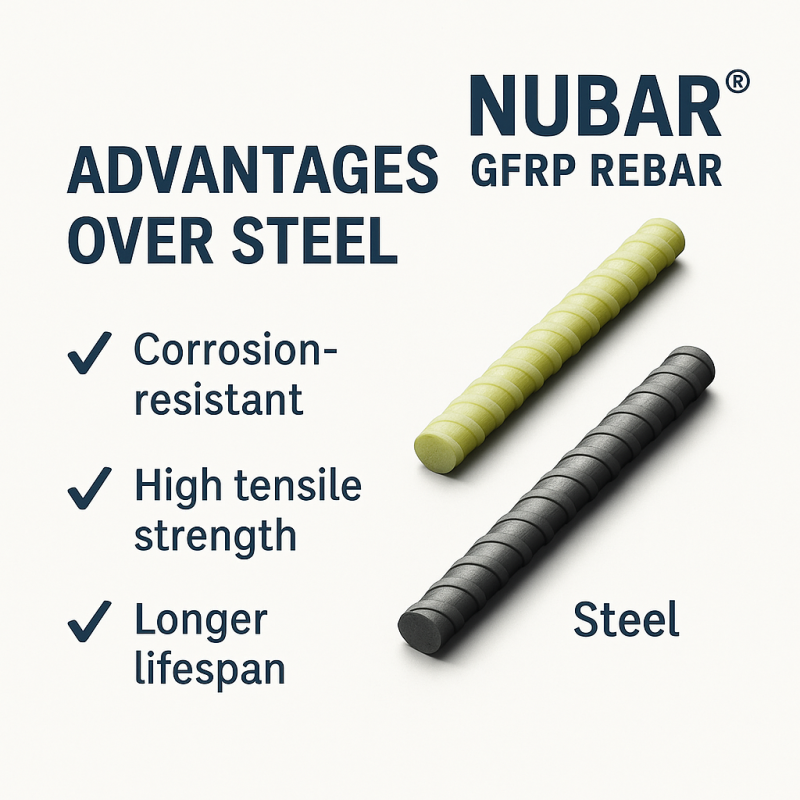
What is GFRP rebar?
GFRP stands for Glass Fibre Reinforced Polymer.
It is a non-metallic composite reinforcement manufactured using continuous glass fibres embedded within a polymer resin matrix.
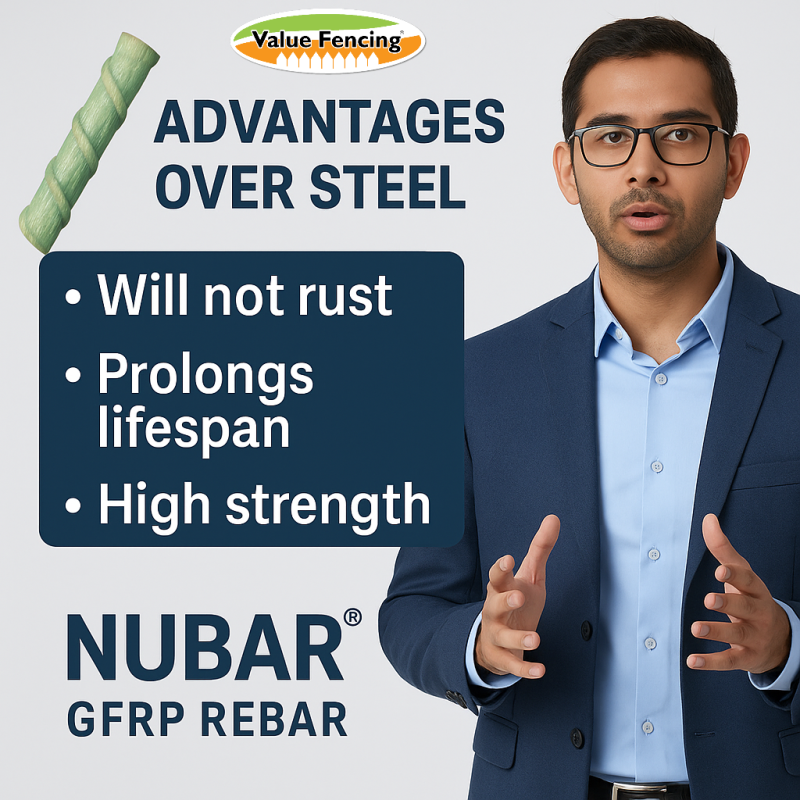
One of its most important advantages in corrosion-sensitive environments is simple:
GFRP does not undergo conventional steel rusting.
For suitable applications, this can make GFRP particularly relevant to:
- Coastal properties
- Seaside developments
- Pool environments
- High-moisture locations
- Selected balustrade installations
- Selected wall-top systems
- Concrete-filled PVC posts
- Projects where reducing concealed ferrous components is desirable
The https://www.concrete.org/store/productdetail.aspx?ItemID=440115&;Language=English&Units=US_AND_METRIC" rel="noopener noreferrer" target="_blank">American Concrete Institute recognises fibre-reinforced polymer reinforcing bars as an alternative reinforcement system and identifies corrosion resistance as one of their important advantages.
Is GFRP automatically better than steel?
No.
That distinction is important.
GFRP and steel are different engineering materials.
They have different physical and mechanical characteristics and should not simply be substituted for one another without considering the application.
The appropriate reinforcement depends on factors such as:
- Fence type
- Balustrade design
- Post height
- Span
- Wind exposure
- Structural loads
- Gate loads
- Foundation
- Fixing method
- Existing structure
Value Fencing® therefore does not promote one reinforcing material as the correct answer for every installation.
The reinforcement should be selected to suit the application.
The major advantage of GFRP in corrosion-sensitive environments is that it is not subject to the conventional rusting mechanism associated with steel.
Why does Value Fencing® use concrete-filled posts?
PVC provides the clean external finish.
Structural support is then incorporated according to the particular system and application.
Selected Value Fencing® installations use reinforced, concrete-filled PVC posts.
Depending on the application, this construction can provide:
- Increased rigidity
- Improved post stability
- Structural support for higher fencing
- Support for privacy fencing
- Improved gate-post performance
- A solid internal core
The final post configuration depends on what the post is expected to do.
A lightweight decorative picket fence does not necessarily require the same reinforcement as:
- A tall privacy screen
- A large driveway gate
- A balustrade
- A high-wind boundary fence
- A wall-top privacy system
This is one of the reasons site-specific design matters.
PVC on the outside - but what is inside the gate?
Large driveway gates introduce another concealed component that buyers should investigate:
The internal structural frame.
A driveway gate must remain sufficiently rigid to:
- Support its own weight
- Carry the PVC infill
- Resist movement
- Maintain alignment
- Operate consistently
- Work with automation where required
Selected Value Fencing® custom gate systems incorporate internal aluminium reinforcement within the PVC frame construction.
This provides structural support without depending on a conventional mild-steel internal gate frame.
For coastal properties, that can be an important long-term consideration.
Why aluminium reinforcement?
Aluminium does not undergo conventional iron rusting.
It also provides useful structural rigidity while remaining relatively lightweight.
This makes aluminium particularly useful in suitable PVC gate applications.
However, responsible specification still matters.
Aluminium should not be described as universally immune to every form of corrosion.
A coastal gate installation should also consider:
- Dissimilar metals
- Fasteners
- Hinges
- Gate wheels
- Automation brackets
- Drainage
- Water retention
- Material compatibility
Again, the complete system matters.
Coastal-grade hardware matters too
There is little value in specifying a corrosion-resistant PVC fence and then fitting unsuitable hinges, latches or fasteners.
Hardware selection should form part of the overall coastal specification.
Depending on the application, Value Fencing® can specify appropriate corrosion-resistant hardware, including selected 316 stainless-steel components.
Applications can include:
- Pedestrian gates
- Pool gates
- Courtyard gates
- Driveway gates
- Balustrades
- Privacy screens
A lightweight garden gate and a large automated driveway gate should not automatically receive the same hardware specification.
Application first. Specification second.
Why PVC is particularly attractive for coastal properties
PVC offers several inherent advantages for coastal property owners.
PVC does not rust
PVC contains no iron and therefore does not undergo conventional rusting.
PVC does not rot
PVC is not subject to the biological decay associated with timber.
No routine painting
PVC does not require routine painting, varnishing or rust treatment.
Termite resistant
PVC is not a food source for termites.
Easy to clean
Ordinary surface dirt can generally be cleaned using water and a mild household detergent.
Multiple architectural styles
PVC can be used to create:
- Palisade fencing
- Picket fencing
- Private fencing
- Semi-private fencing
- Horizontal screens
- Vertical screens
- Pool fencing
- Balustrades
- Pedestrian gates
- Sliding driveway gates
- Swing driveway gates
- Lattice
- Trellis
- Pergolas
- Equestrian fencing
- Custom CNC-manufactured solutions
Is all PVC fencing the same?
No.
This is one of the most important questions homeowners, architects and developers should ask.
Simply describing something as "PVC fencing" does not tell you:
- The dimensions of the profiles
- Wall thickness
- How the posts are reinforced
- What is inside the gates
- What hardware is used
- How the fence is anchored
- Whether posts are concrete filled
- Post spacing
- Wind-load considerations
- Suitability for the required height
- How wall-top sections are fixed
- What the warranty actually covers
Two fencing systems can look very similar from several metres away while being very different internally.
That difference may only become obvious years later.
What should you ask before buying coastal fencing?
Before accepting a quotation, ask the supplier these questions.
1. What is the external material?
PVC, aluminium, steel, timber or another material?
2. How are the posts reinforced?
Do not assume a post is structurally solid simply because it looks substantial.
3. Are the posts concrete filled?
If so, ask:
What reinforces the concrete?
4. What is inside the gate?
Ask specifically whether the internal structure uses:
- Mild steel
- Aluminium
- Composite reinforcement
- Another structural system
5. What hardware is being used?
Ask about:
- Hinges
- Latches
- Fasteners
- Gate wheels
- Automation brackets
6. Has the system been specified for coastal exposure?
The word "coastal" should mean more than a marketing statement.
7. What does the warranty actually cover?
Material warranty and installation workmanship warranty are different protections.
Why total cost of ownership matters
The purchase price is only one part of the cost of fencing.
Property owners should also consider future expenditure such as:
- Sanding
- Priming
- Painting
- Rust treatment
- Timber sealing
- Corrosion repairs
- Replacement of deteriorated sections
- Labour
- Access equipment
- Disruption to residents or tenants
PVC changes that maintenance equation because the PVC itself does not require routine painting or rust treatment.
For homeowners, body corporates, estates, hotels, retirement developments, schools, property managers and developers, this can become an important long-term consideration.
Coastal PVC fencing for Cape Town and the Western Cape
The Western Cape contains some of South Africa's most demanding coastal environments.
Value Fencing® serves customers through approved local outlets and service areas across regions including:
- Cape Town
- Cape Peninsula
- False Bay
- Fish Hoek
- Simon's Town
- Atlantic Seaboard
- Cape Winelands
- Saldanha
- Langebaan
- Cape West Coast
- Whale Coast
- Garden Route
Local service availability differs according to territory.
Use the official Value Fencing® location structure to find the outlet or representative currently serving your property.
Coastal PVC fencing in the Eastern Cape
PVC is particularly relevant to Eastern Cape coastal environments.
Value Fencing® serves selected areas including:
- Gqeberha
- Jeffreys Bay
- East London
- Surrounding approved service areas
Coastal wind exposure and proximity to the ocean should form part of the final installation specification.
Coastal PVC fencing in KwaZulu-Natal
KwaZulu-Natal's warm, humid coastal environment creates a different combination of exposure conditions.
Value Fencing® has been involved in PVC installations in KwaZulu-Natal since the early history of the brand.
Applications include:
- Residential boundary fencing
- Estates
- Pool fencing
- Gates
- Privacy screens
- Balustrades
- Equestrian fencing
PVC fencing for Namibia's coast
Namibia's coastal environments create another combination of:
- Marine exposure
- Wind
- Sand
- Dry conditions
- Coastal moisture
Value Fencing® products and services are available in Namibia through approved local representation and supply arrangements, including Windhoek and Swakopmund.
Availability should be confirmed for the specific project location.
Coastal fencing for estates and developments
For larger developments, fencing should be treated as part of the overall property specification.
Value Fencing® can assist architects, developers, quantity surveyors and estate managers with:
- Product selection
- Fence style
- Required privacy
- Gate integration
- Balustrade options
- Pool fencing
- Screening systems
- Reinforcement options
- Technical information
- Project-specific configurations
- Material schedules
- Development colour options where minimum manufacturing quantities apply
- Installation planning
This creates consistency across the development rather than treating every fence, gate and screen as an unrelated component.
Coastal PVC balustrades
Balustrades require particular attention because they are safety-critical building components.
They should not be treated as ordinary decorative fencing.
A balustrade installation may need to consider:
- Height
- Vertical openings
- Structural loading
- Fixing points
- Existing slab or wall construction
- Post reinforcement
- Applicable building requirements
- Site-specific engineering requirements
For coastal applications, reinforcement and hardware selection become particularly important.
Where appropriate to the design, non-corrosive GFRP reinforcement can help reduce dependence on concealed steel reinforcement in chloride-prone environments.
https://valuefencing.co.za/pvc-balustrade-railing-compliant-durable-stylish" rel="noopener noreferrer" target="_blank">View Value Fencing® PVC Balustrades & Railings
https://valuefencing.co.za/pvc-balustrade-3-rail-estate-style" rel="noopener noreferrer" target="_blank">View the Value Fencing® 3-Rail Estate Style PVC Balustrade
Coastal PVC pool fencing
Pool environments expose fencing systems to:
- Water
- Moisture
- Cleaning chemicals
- Irrigation
- Frequent washing
When a swimming pool is also close to the ocean, material selection becomes even more important.
Value Fencing® PVC pool fencing can be configured with:
- Suitable vertical openings
- Reinforced posts
- Self-closing gate systems
- Appropriate latch arrangements
- Corrosion-conscious hardware selection
Pool compliance depends on the complete enclosure and gate system, not merely the material from which the fence is manufactured.
https://valuefencing.co.za/pages/view/1/pvc-fencing-pool-fence-gates" rel="noopener noreferrer" target="_blank">View Value Fencing® PVC Pool Fencing & Gates
Coastal PVC privacy fencing
Privacy fencing requires particular structural consideration because a solid fence catches substantially more wind than an open palisade or picket fence.
A tall privacy fence therefore needs proper consideration of:
- Post spacing
- Foundation size
- Reinforcement
- Fence height
- Ground conditions
- Wind exposure
- Existing walls
A 1.8 m or 2.1 m solid privacy fence behaves very differently in strong wind from an open decorative fence.
https://valuefencing.co.za/pvc-fencing-privacy-wall-fence" rel="noopener noreferrer" target="_blank">View Value Fencing® PVC Private Boundary Fencing
PVC palisade fencing for coastal properties
Palisade-style PVC fencing provides an open configuration that can be particularly useful where airflow, visibility and reduced wind resistance are important.
Value Fencing® PVC palisade systems are available in different heights, picket sizes and spacing configurations according to the application.
https://valuefencing.co.za/pages/view/10/pvc-fencing-palisade-fence" rel="noopener noreferrer" target="_blank">View Value Fencing® PVC Palisade Fencing
Horizontal PVC screening at the coast
Modern horizontal screens can provide excellent architectural privacy.
However, screening systems must be designed with wind exposure in mind.
Closer spacing and taller screens create greater wind resistance.
Post spacing, reinforcement and fixing methodology should therefore be selected according to the application rather than merely copying the appearance of another installation.
https://valuefencing.co.za/pages/view/8/pvc-horizontally-slatted-screens-gates" rel="noopener noreferrer" target="_blank">View Value Fencing® Horizontal PVC Screens & Gates
What about wall-top fencing and screens?
Wall-top installations require a different approach from posts installed directly into the ground.
Before adding fencing or screening to an existing wall, factors may include:
- Wall construction
- Wall condition
- Existing foundations
- Fence height
- Wind loading
- Fixing positions
- Reinforcement
- Nearby structures
A wall that looks substantial does not automatically mean it is structurally appropriate for a tall solid privacy screen.
Site-specific assessment remains important.
PVC gates for coastal properties
Coastal driveway and pedestrian gates should be assessed as complete mechanical systems.
Important considerations include:
- Internal gate frame
- Gate width
- Gate weight
- Hinges or wheels
- Latches
- Automation
- Reinforcement
- Coastal exposure
Value Fencing® manufactures custom pedestrian, courtyard, sliding and swing driveway gates according to the selected fencing style and project requirements.
For selected gate systems, internal aluminium reinforcement is incorporated within the PVC frame construction to provide structural rigidity without relying on a conventional mild-steel internal gate frame.
Value Fencing® - PVC specialists since 2009
Value Fencing® has specialised in PVC fencing and related outdoor PVC solutions in Southern Africa since 2009.
Our product range includes:
- PVC Palisade Fencing
- PVC Picket Fencing
- Private Boundary Fencing
- Semi-Private Fencing
- Horizontal Screening
- Vertical Screening
- Pool Fencing
- PVC Balustrades
- Pedestrian Gates
- Sliding Driveway Gates
- Swing Driveway Gates
- Pergolas
- Arbors
- Lattice
- Trellis
- Equestrian Fencing
- Shutters
- Custom CNC-designed PVC projects
Our approach is straightforward:
Specify the solution around the property, the environment and the intended application.
Value Fencing® warranty
Qualifying Value Fencing® PVC materials are covered by our:
Limited Lifetime Warranty - Minimum 20 Years
The warranty applies subject to the applicable Value Fencing® written warranty terms, conditions and exclusions.
Professional Value Fencing® installations additionally carry a separate:
12-Month Workmanship Warranty
The material warranty and workmanship warranty are separate protections.
Customers should always understand exactly what each warranty covers before committing to a project.
Frequently Asked Questions About Coastal PVC Fencing
Does PVC fencing rust?
No.
PVC itself does not rust because it does not contain iron.
Any reinforcement, hardware and other components should still be appropriately specified for the environment.
Does PVC fencing rot?
No.
PVC is not subject to the biological decay associated with timber.
Does PVC fencing need painting?
PVC does not require routine painting, varnishing or rust treatment.
Occasional cleaning may still be required depending on the environment.
Is PVC fencing suitable near the ocean?
Yes.
PVC is particularly attractive for many coastal applications because the PVC itself does not rust or rot.
The complete installation should still be designed around wind exposure, ground conditions, structural requirements and the intended application.
What is GFRP rebar?
GFRP stands for Glass Fibre Reinforced Polymer.
It is a non-metallic composite reinforcement material.
One of its important characteristics for corrosion-sensitive applications is that it does not experience conventional steel rusting.
Why use GFRP inside a PVC post?
Where a concrete-filled PVC post requires reinforcement, GFRP can provide reinforcement without introducing conventional steel corrosion into suitable applications.
The reinforcement must still be correctly selected and designed for the application.
Do all Value Fencing® posts contain GFRP?
No.
The reinforcement specification depends on the product, application and structural requirements.
Different fencing, gate, screen and balustrade systems require different reinforcement strategies.
Why use aluminium reinforcement inside PVC gates?
Large PVC gates require internal structural support.
Selected Value Fencing® gate systems can incorporate aluminium reinforcement because it provides rigidity without relying on a conventional mild-steel internal frame.
Does aluminium rust?
Aluminium does not undergo conventional iron rusting because it contains no iron.
However, aluminium can still experience other forms of corrosion, particularly where poor detailing or incompatible materials are present.
Correct specification remains important.
Can Value Fencing® assess my coastal property?
Yes.
Where local installation services are available, a Value Fencing® representative can assess the proposed fence line, gate opening, existing walls, levels, exposure and project requirements before final specification.
Planning a coastal PVC fencing project?
Every coastal property is different.
To help us assess your requirements, send us:
- Your suburb, town or project location
- Approximate fence lengths
- Required height
- Photographs of the proposed installation area
- Your preferred fence, screen or gate style
- Gate dimensions where applicable
- Details of any existing walls or structures
A Value Fencing® representative can then help identify the appropriate system and, where required, arrange a detailed site assessment.
Choose a fencing solution designed around your environment - not a generic one-size-fits-all product.
https://valuefencing.co.za/" rel="noopener noreferrer" target="_blank">Request a Value Fencing® Quote
https://valuefencing.co.za/" rel="noopener noreferrer" target="_blank">Find Your Local Value Fencing® Outlet
Value Fencing®
Since 2009
Limited Lifetime Warranty - Minimum 20 Years on qualifying PVC materials, subject to applicable warranty terms.
"Everything in business is negotiable, except Quality."
Technical References
https://www.concrete.org/store/productdetail.aspx?ItemID=440115&;Language=English&Units=US_AND_METRIC" rel="noopener noreferrer" target="_blank">American Concrete Institute - Guide for the Design and Construction of Structural Concrete Reinforced with Fiber-Reinforced Polymer Bars
https://www.fhwa.dot.gov/publications/research/infrastructure/structures/09020/chapt1.htm" rel="noopener noreferrer" target="_blank">U.S. Federal Highway Administration - Corrosion Resistant Alloys for Reinforced Concrete
https://www.fhwa.dot.gov/publications/research/infrastructure/pavements/pccp/01163/app.cfm" rel="noopener noreferrer" target="_blank">U.S. Federal Highway Administration - Guidelines for Detection, Analysis and Treatment of Materials-Related Distress in Concrete