
Disclosure Document - Value Fencing®
Navigation
Architect's Drawing: PVC Pergola Specifications, Profiles, Components, Assembly, and Installation

Author: Willie Labuschagne - MD - Value Fencing PVC Franchise Group Team, Published: 2025
Options

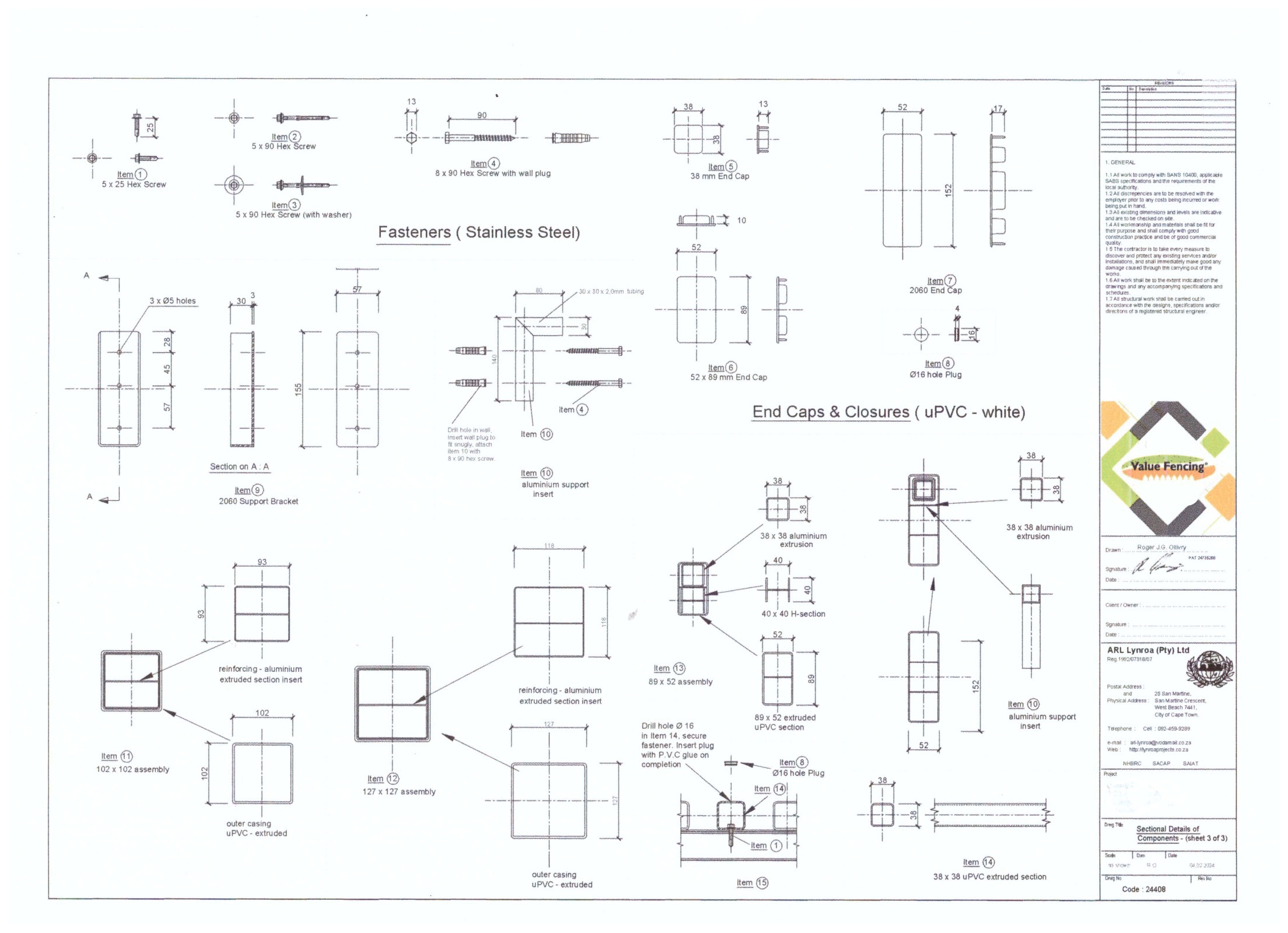
Description
Architect's technical specification and construction guide
By Willie Labuschagne, MD, Value Fencing® Franchise Group · Published 3 February 2025
This drawing pack covers the Value Fencing® PVC pergola system: profiles, components, assembly, engineering notes, SANS 10400 considerations and construction sequence. It is for architects, engineers, project managers, draughtsmen, builders and estate approval committees. Use it with Download JPG or View JPG above.
1. System overview
Locally extruded PVC. Profiles are extruded in South Africa from uPVC specified for African UV exposure.
Reinforced structure. Load-bearing members use aluminium or steel reinforcement sleeves and concrete-filled post cores as required.
Modular configurations:
- Free-standing pergolas
- Wall-mounted pergolas
- Garden arbors
- Patio shade structures
- Carport pergolas
- Custom CNC-cut fixed louvre pergolas
- Slatted, trellis or polycarbonate top coverings
Low maintenance. PVC does not need sanding, varnishing, painting, staining, waterproofing or corrosion protection.
2. Material specifications
uPVC composition
- Virgin unplasticised PVC
- 4× UV-stabilised (African solar load)
- High-impact modifiers
- DuPont TiO₂ whitening / UV protection
- No calcium carbonate fillers (reduces brittleness and chalking)
- ASTM-certified fencing-grade polymer formulation
Colours
- Standard: white
- Custom colours: acrylic roof paint after light sanding
3. Profile specifications (typical)
Structural posts
- 102×102 mm square PVC post
- Wall thickness: ±4.5–5 mm
- Reinforcement:
- 2× Y10 or Y12 rebars (600 mm)
- Rawl epoxy anchoring
- Concrete fill: 25–30 MPa
- 127×127 mm heavy-duty post (optional)
Main beams
- 152×51 mm rafters / beam profiles
- Aluminium sleeve insert for spans
- Lintel support options for broader spans
Rafter options
- 38×152 mm
- 38×89 mm
- Custom CNC-cut decorative ends
Louvre / slat options
- Fixed CNC-cut louvres (sun-block angle 0–30°)
- 22 mm, 38 mm, 50 mm, 76 mm slats
- Fully slatted shade panels
- Trellis or lattice infill panels
Top cover options
- Open slatted
- Solid slatted shade top
- Fixed-angle louvre top
- Multi-direction CNC-cut louvred screens
- Polycarbonate roof sheeting
- Classic lattice or trellis shading
4. Component breakdown
A. Primary structural components
- Load-bearing PVC posts
- Aluminium-reinforced PVC beams
- Rafters with reinforcing
- Wall plate (if wall-mounted)
- Base connectors (post-footing hardware optional)
B. Secondary components
- CNC-cut decorative rafter tails
- Louvre panels
- Slatted infill sections
- Shade battens
- Polycarbonate mounts (where applicable)
C. Connectors and hardware
- Stainless-steel fasteners
- Aluminium L-brackets
- PVC rail connectors
- Wall-mounting brackets
- Beam-to-post concealed fixing
Hardware is specified as corrosion-resistant for coastal installation.
5. Assembly and installation
Step 1: Site measurement and ground prep
- Verify plumb lines and grade slope
- Establish datum level
- Mark post placements
Step 2: Foundation footing
- Core drill or excavate 300–600 mm
- Anchor 2× Y10 rebars 150 mm into the substrate
- Embed the post using Rawl epoxy
- Fill the post with 25–30 MPa concrete
- Allow adequate curing time
Step 3: Beam installation
- Slide the aluminium sleeve inside the PVC beam
- Fix beams to posts with concealed brackets
- Check level and square
Step 4: Rafter installation
- Space rafters uniformly (typically 500–900 mm)
- Secure with stainless-steel screws
- Add decorative tails if specified
Step 5: Infill and top structure
- Fixed louvre panels
- Slatted shading
- Trellis top
- Polycarbonate cover
- Combinations of the above
Step 6: Finishing
- Cap posts with standard, gothic or New England caps
- Fit edge trims, shade rails or decorative trims
6. Performance and compliance
Wind load and structure. PVC beams with aluminium sleeves provide lateral rigidity and vertical load-bearing as specified in the drawing.
SANS 10400. Pergolas often fall under minor building work, but structural or municipal approval may still be required if:
- Covered area exceeds about 20 m²
- Attached load exceeds the usual thresholds
- Estate guidelines require a formal submission
Confirm with the local authority and HOA. This note is not a substitute for SANS 10400 or a registered professional.
Thermal stability. Profiles are UV-stabilised to limit fading, chalking, brittleness and discolouration.
Moisture, pest and decay. PVC is non-absorbent, does not rot, and is not a food source for termites.
7. Architectural applications
- Patios and entertainment areas
- Courtyards and pool decks
- Walkways and garden paths
- Estate-approved shade structures
- Contemporary louvre pergolas
- Val de Vie-style outdoor living
- Heritage-sensitive structures
- Carports and vehicle shade pergolas
8. Benefits for architects and builders
- Consistent, predictable profiles
- No warping, splitting or shrinkage
- Wide customisation (including CNC louvres)
- Suited to estates and modern developments
- Compatible with 3D BIM modelling
- No routine repainting
- Lightweight with internal reinforcement
- Longer service life than typical timber in outdoor exposure
9. Frequently asked questions
Can the pergola be installed on paving or a slab?
Yes, with core drilling and epoxy anchoring as specified.
Can I specify custom louvre angles?
Yes. CNC machining allows specified sun-control angles.
What is the maximum rafter span?
Typically 2.1–3.0 m, depending on reinforcement. Check the drawing for the span you are specifying.
Can PVC pergolas handle coastal climates?
PVC does not corrode; profiles and hardware are specified as UV-stabilised and corrosion-resistant for coastal use.